You know the feeling. It is mid-July in Menifee. The clock strikes 3:00 PM. You step outside, and the heat hits you like a physical wall. The concrete burns your feet, and the air feels heavy. You retreat inside, expecting cool relief, but you notice your vents are blowing lukewarm air.
This scenario is a nightmare for any homeowner in Riverside County. In Menifee, air conditioning is not a luxury; it is a life-support system. When temperatures climb into the triple digits, a broken AC unit turns your home into an oven within hours.
Summer 2026 brings new challenges. We face forecasted heatwaves, new refrigerant regulations, and evolving energy rates from Southern California Edison (SCE). Preparation is your only defense. This guide provides a detailed checklist to ensure your HVAC system survives the season, keeps your bills manageable, and keeps your family safe.
The Menifee Heat Forecast for Summer 2026
To prepare correctly, you must understand what is coming. The local climate in Menifee behaves differently than coastal California.
The “100°F Club”
Meteorologists predict a punishing summer for the Inland Empire. Historical data and current trends suggest we will see over a week of consecutive days where temperatures exceed 105°F.
During these heat spikes, your air conditioner runs almost non-stop. If your system is dirty, low on refrigerant, or aging, these are the days it will fail. A system operating at 70% capacity might handle a 90°F day. On a 105°F day, that same system will overheat and shut down.
The “Dust & Wind” Factor
Menifee sits in a valley that acts as a wind tunnel. You see this every afternoon. The wind picks up dust, pollen, and dry vegetation. This debris does not just land on your car; it gets sucked directly into your outdoor AC unit (the condenser).
The condenser needs to “breathe” to release heat. When dust coats the metal fins, the unit suffocates. It works harder to push heat out, which drives up your electric bill and strains the compressor. Unlike homes in Temecula or Murrieta that might have more wind protection from hills, Menifee homes often take the brunt of these dust storms.
Wildfire Watch 2026
Heat is only part of the problem. Late summer brings wildfire season. Smoke contains fine particulate matter that bypasses standard filters. If a fire starts near Lake Elsinore or Diamond Valley Lake, the ash fallout will clog your AC filters in days, not months. You need a plan to handle both the heat and the smoke simultaneously.
The 2026 Regulatory Shift: Is Your AC Obsolete?
If your air conditioner is more than 10 years old, you need to pay close attention to this section. The rules for repairing AC units changed drastically in late 2024 and 2025.
The Death of R-410A
For years, R-410A (often called Puron) was the standard refrigerant. The EPA has phased it out to reduce greenhouse gas emissions. As of 2026, manufacturers no longer produce new residential units that use R-410A.
This means the supply of R-410A is shrinking, and the price is skyrocketing. If your older unit springs a leak this summer, the cost to recharge it might shock you. We are seeing refrigerant costs that are triple what they were just two years ago.
The New Standard (A2L Refrigerants)
New systems installed in 2026 use A2L refrigerants like R-454B or R-32. These are mildly flammable but highly efficient.
If a technician tells you that your compressor is dead, you cannot simply drop a new R-410A compressor into an old unit easily. You will likely face a choice: pay a premium to fix an obsolete machine or invest in a completely new system compatible with the new standards.
Repair vs. Replace Math
Here is the hard truth for 2026. If your system is over 12 years old and requires a major repair (like a compressor or a refrigerant leak fix), the math rarely works in favor of repair. You would be pouring money into a “zombie” system. However, if your system is newer, protecting it with maintenance is critical to avoid these expensive decisions.
The Essential DIY Homeowner Checklist (Do This in May)
You do not need a license to perform basic maintenance. These simple steps can improve your system’s efficiency by 20% or more.
The “Cottonwood” Check
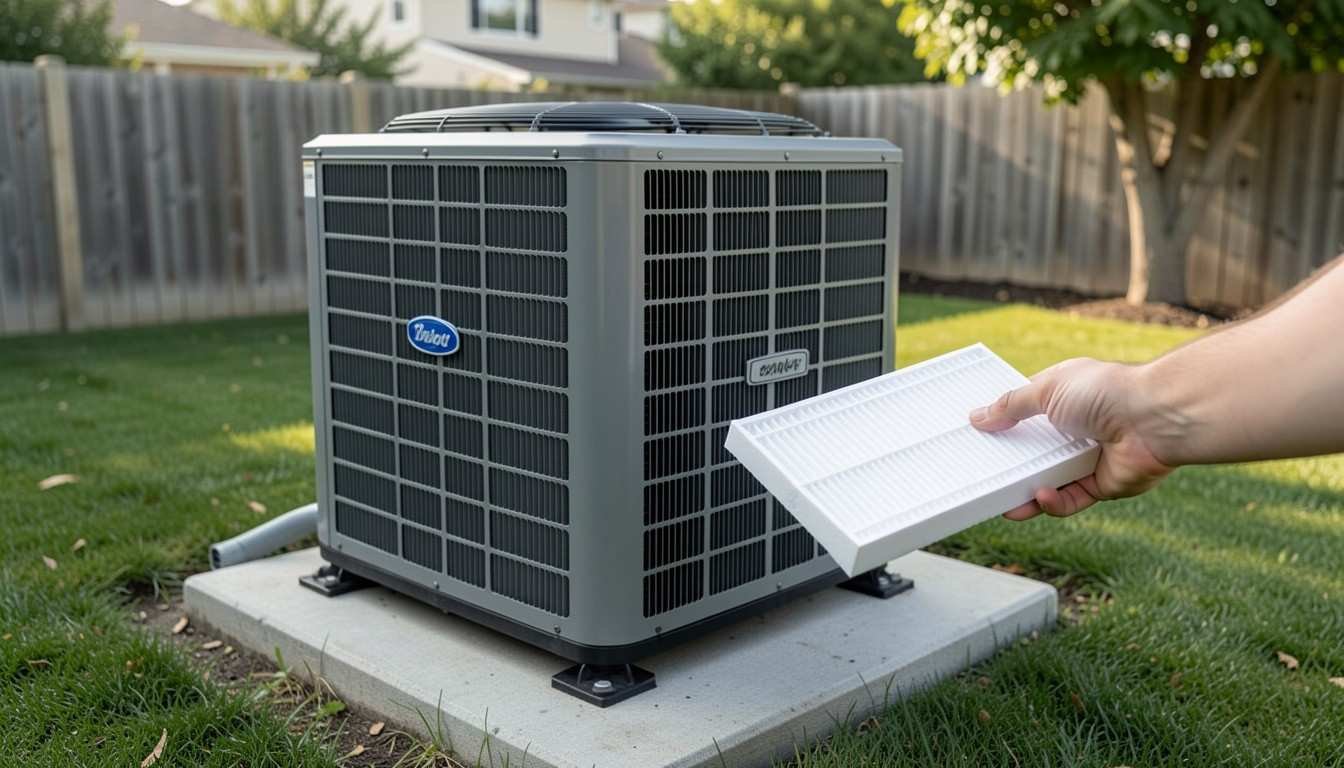
Go outside to your condenser unit. Look at the metal fins. In Menifee, these often get coated in a white, fuzzy layer of pollen, cottonwood seeds, or dust. This layer acts like a winter coat for your AC.
How to clean it:
- Turn off the power to the unit at the disconnect box (the grey box on the wall near the unit).
- Take a garden hose with a standard spray nozzle.
- Do not use a pressure washer. High pressure will bend the delicate aluminum fins.
- Spray water gently from the top down to wash the debris off.
- Let it dry before turning the power back on.
Filter Strategy
Your air filter is the lungs of your house.
- Standard Summer: Use a MERV 8 to MERV 11 filter. These capture dust and pollen but still allow enough airflow for the system to cool your home efficiently.
- Fire Season: Keep a box of MERV 13 filters in the garage. If smoke fills the valley, swap in the MERV 13. It blocks fine smoke particles. Crucial: Check this filter every week during smoke events. A clogged MERV 13 filter restricts airflow so much it can freeze your evaporator coil.
Thermostat Logic
Stop fighting the sun. You cannot cool your house to 68°F when it is 105°F outside. The machine simply cannot remove heat that fast.
Instead, use Pre-Cooling.
- 10 AM – 3 PM: Set your thermostat to 72°F. Electricity is cheaper, and the ambient air is cooler. Cool the thermal mass of your home (furniture, walls, floors).
- 4 PM – 9 PM: This is the SCE “On-Peak” window. Raise the thermostat to 78°F or higher. Your home acts like a battery, holding the cool air from earlier. Your AC runs less when power is most expensive.
The “Drain Line” Test
Every AC unit produces water (condensate). This water drains out through a white PVC pipe, usually near your outdoor unit.
Algae loves to grow in these wet pipes. If the algae forms a clog, the water backs up. It triggers a safety switch that shuts off your AC, or worse, it overflows into your attic and ruins your ceiling.
The Fix: Find the cleanout port on your indoor unit (usually in the attic or garage). Pour one cup of distilled white vinegar down the line. This kills the algae and keeps the water flowing.
The Professional Tune-Up: What We Do That You Can’t
DIY steps are great, but they do not cover everything. An AC unit is a complex high-voltage machine. Professional maintenance looks at the internal health of the system.
Capacitor Testing
The capacitor is like a battery that kickstarts your compressor. The heat in Menifee kills capacitors. A weak capacitor might still start your AC, but it forces the motor to work harder.
We use a multimeter to test the microfarads. If a capacitor is rated for 45 microfarads but reads 38, it is a ticking time bomb. We replace it before it fails on a Sunday afternoon.
Contactor Inspection
The contactor is a switch that turns the high voltage on and off. Every time it clicks, a small electrical arc occurs. Over thousands of cycles, the metal contacts get pitted and burnt.
A bad contactor can stick in the “closed” position. This means your outdoor unit keeps running even when the thermostat turns off. The compressor eventually overheats and burns out. We inspect these contacts and replace them if they show pitting.
Refrigerant Level Check (Subcooling/Superheat)
You cannot guess refrigerant levels by feeling the air. We connect gauges to measure “Subcooling” and “Superheat.”
- Too Low: You have a leak. The coil will freeze.
- Too High: Someone overcharged the unit. The compressor will die from liquid slugging.
We dial these numbers in to the manufacturer’s exact specifications. This ensures you get the maximum cooling capacity for every dollar of electricity you spend.
Ductwork Integrity
Menifee attics get hot. Rats and mice look for shelter there. They often chew through flexible ductwork. If you have a hole in your duct, you are paying to air condition your attic while your living room stays hot. We inspect the ducts for tears, crushed sections, or disconnected joints.
Beating the Bill: Surviving SCE’s 2026 Summer Rates
Electricity costs are a major concern for local homeowners. SCE rates continue to evolve, and summer peaks are punishing.
The $0.74/kWh Reality
During peak summer hours (usually 4 PM to 9 PM), rates can soar to over $0.70 per kilowatt-hour on certain tiered plans. Running your AC at full blast during this time is financial suicide.
Smart Thermostat Hacks
If you do not have a smart thermostat (like Nest or Ecobee), get one.
- Eco-Mode: Use features that automatically adjust the temperature when you leave the house. Geofencing uses your phone’s location to know when you are away.
- Occupancy Sensors: These sensors detect which rooms you are using. The system can prioritize comfort where you are, rather than cooling an empty guest room (if you have a zoned system).
Whole-House Fans
This is the Menifee secret weapon. Even in summer, our desert climate cools down significantly at night. A whole-house fan mounts in your ceiling.
In the early morning (6 AM), open your windows and turn on the fan. It sucks the cool 65°F air in and pushes the hot stale air out through the attic vents. You can cool your entire home instantly for pennies. Then, shut the windows and trap that cool air inside for the day.
Emergency Protocol: When the AC Dies in July
Despite your best efforts, machines break. If your AC stops working in the middle of a heatwave, stay calm.
Don’t Panic: Check the Basics
Before you call for service, check these three things:
- The Breaker: Check your electrical panel. Did the AC breaker trip? Flip it off and back on once. If it trips again, stop. You have a short circuit.
- The Filter: Is the filter completely clogged? Remove it and see if airflow returns.
- The Thermostat: Do the batteries need replacement? Is it set to “Cool” and not “Fan On”?
Portable Solutions
We recommend every Menifee homeowner own one portable AC unit or a window unit. You can buy one for $300-$400. If your central system fails, you can set this up in a master bedroom or living room. It provides a “safe zone” where the family can sleep and stay cool while you wait for parts or a technician.
Our “Priority Service”
During a heatwave, wait times for repairs can extend to days. This is industry-wide. However, regular maintenance customers often get priority booking. Establishing a relationship with a local service provider before the emergency puts you at the front of the line.
Conclusion
Summer in Menifee is predictable. It will be hot. It will be dusty. And it will be expensive. Your HVAC system is the only thing standing between you and that heat.
Treat your air conditioner like you treat your car. You wouldn’t drive your car across the desert without checking the oil and tires. Do not force your AC to run a Menifee summer marathon without a tune-up.
Clear the debris. Check the filter. Test the drain line. If you are uncomfortable touching the high-voltage components, call a professional. A small investment in May saves you from a massive headache in August. Stay cool, Menifee.
Frequently Asked Questions (FAQs)
When should I schedule my AC tune-up in Menifee?
The ideal time is between March and May. You want to service the unit before the first heatwave hits. Once June arrives, technicians are often booked solid with emergency repairs. Booking early also ensures you catch small problems before they turn into breakdowns.
Can I rinse my outdoor AC unit with a garden hose?
Yes, and you should. Use a standard hose with a gentle spray nozzle. Spray water through the metal fins to wash away dust and pollen. Warning: Never use a pressure washer. The high pressure will crush the delicate aluminum fins, blocking airflow permanently. Also, ensure the power is off before spraying water near the electrical components.
What is the best thermostat setting for Menifee summers?
Energy Star recommends 78°F when you are home. However, comfort is personal. A smart strategy is “Pre-Cooling.” Set your thermostat to 72°F–74°F from 10 AM to 3 PM when electricity is cheaper. Then, raise it to 78°F or higher during the 4 PM–9 PM peak pricing window. This keeps the home comfortable without paying peak rates.
My AC is 15 years old. Should I replace it before summer 2026?
You are in the “danger zone.” A 15-year-old unit likely uses R-410A refrigerant, which is now being phased out. If that unit develops a leak, the repair cost will be extremely high. If the unit has a history of breakdowns or struggles to keep up, replacing it proactively in the spring is smarter than waiting for it to die during a July heatwave.
Does smoke from wildfires damage my AC unit?
Smoke itself rarely damages the metal components, but the ash and particulate matter are major problems. Smoke clogs air filters incredibly fast. A clogged filter restricts airflow, which can cause the evaporator coil to freeze into a block of ice. During fire season, check your filter every week.