You rely on your appliances every single day. The refrigerator keeps your food safe. The washing machine handles the never-ending laundry pile. The air conditioner makes living in Menifee bearable during July. When one of these machines stops working, it throws your entire routine into chaos.
We understand that frustration. At Appliance Repair Menifee, we field dozens of calls every week from homeowners facing the same specific issues. You might think your broken appliance is a unique disaster, but chances are, your neighbors are dealing with the exact same problem.
This guide breaks down the five most frequent repair calls we receive. We will explain why these specific failures happen so often in our area, how to troubleshoot them yourself, and when you need to bring in a professional.
The “Menifee Effect” on Appliances
You might wonder why your sister in San Diego has a 15-year-old washing machine that still works perfectly, while yours is acting up after just six years. Location matters.
Menifee presents a unique environment for household appliances. We deal with three major factors that accelerate wear and tear:
- Extreme Heat: Our garages and attics get much hotter than coastal areas, stressing refrigeration and HVAC components.
- Hard Water: As discussed in our previous posts, our water mineral content is high, which destroys valves and pumps.
- Dust and Wind: The valley geography means more dust enters your home, clogging vents and coils.
These factors create what we call the “5-Year Itch.” Nationally, appliances might run trouble-free for a decade. In Menifee, we see a distinct spike in service calls for units that are between five and seven years old. Knowing this helps you prepare and maintain your machines better.
#1: The Refrigerator That “Sweats” or Won’t Cool
This is our number one emergency call. You open the fridge, and the milk smells sour. Or maybe you notice a puddle of water on the floor near the front legs.
The Symptom
The most common signs are a freezer that works fine while the fridge section is warm, excessive condensation (sweating) on the ceiling of the fridge, or a loud buzzing noise coming from the back.
The Menifee Cause: Dirty Condenser Coils
Your refrigerator cools by removing heat from the inside and releasing it into your kitchen. It does this through a set of black metal coils, usually located at the bottom or back of the unit.
In Menifee, these coils act like magnets for dust, pet hair, and lint. When a layer of dust covers the coils, the refrigerator cannot release the heat. The compressor has to run constantly to keep up. Eventually, it overheats and shuts down on a safety overload.
The Fix:
Pull your fridge away from the wall. Unplug it. Remove the lower rear panel. Use a coil brush and a vacuum to clean the dust off the coils. If you do this once a year, you can double the life of your compressor.
The Menifee Cause: Garage Fridge Failure
Many of you have a second fridge in the garage. Standard refrigerators are designed to operate in room temperatures between 55°F and 90°F.
In a Menifee summer, your garage can hit 110°F. The fridge struggles to cool, and the oil in the compressor thins out, leading to mechanical failure. In winter, if the garage drops below 40°F, the fridge “thinks” the food is already cold enough and the freezer thaws out.
The Fix:
If you keep a fridge in the garage, you need a “Garage Kit.” This is a small heater installed near the thermostat that tricks the fridge into running properly during cold snaps. For heat issues, ensure good airflow around the unit, but understand that a garage fridge will always have a shorter lifespan here.
#2: The Washing Machine That Smells or Won’t Fill
Laundry issues are a close second. The most frequent complaint is not that the machine won’t spin, but that it smells terrible or takes forever to fill with water.
The Symptom
You start a load, and walk away. You come back 20 minutes later, and the machine is displaying an error code like “LF” (Low Flow) or “IE” (Input Error). Or, you open the door of your front loader and get hit with a smell like rotten eggs or mildew.
The Menifee Cause: Hard Water Scale on Inlet Valves
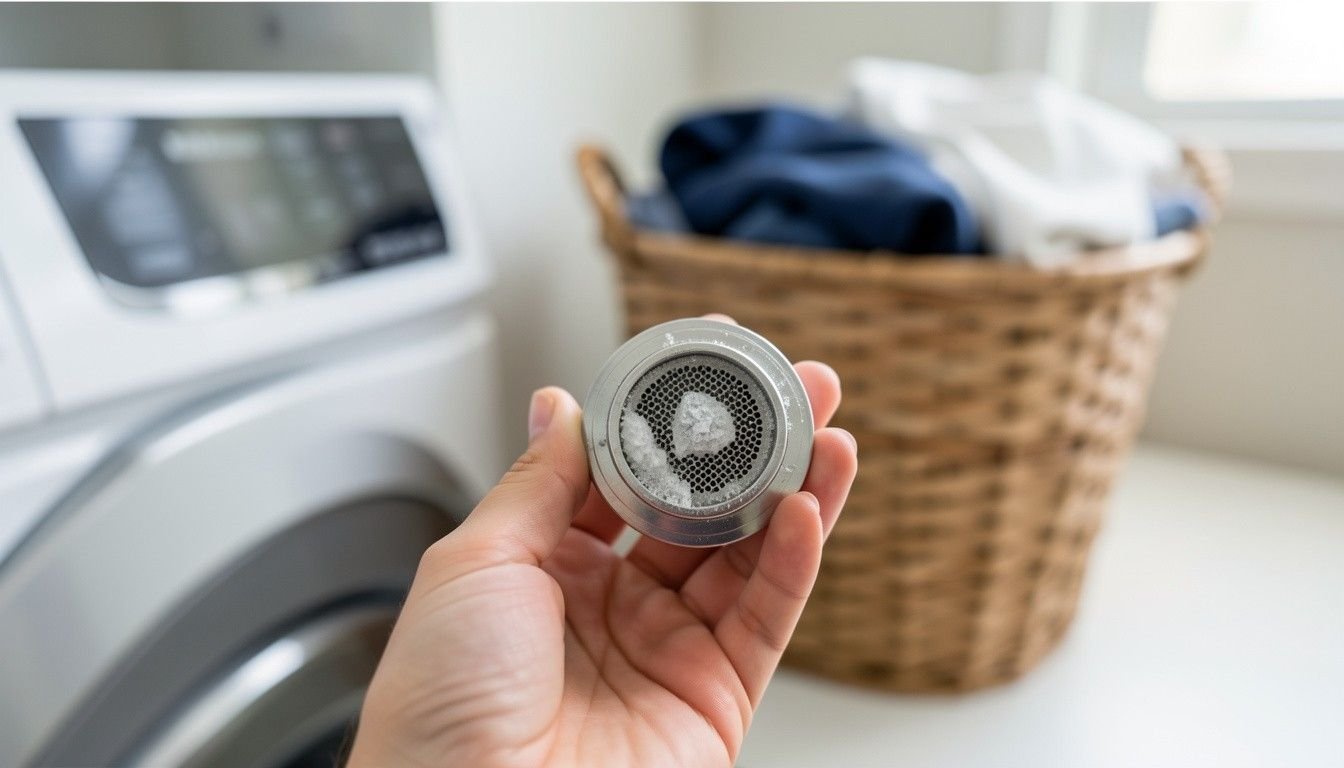
Your washing machine has hot and cold water inlet valves. Inside the connection point, there are tiny mesh screens designed to catch sediment.
Menifee’s hard water contains calcium and magnesium. These minerals form white, crusty deposits on those mesh screens. Over time, the screen becomes a solid wall of rock. Water cannot get through. The machine opens the valve, detects no water entering, and throws an error code.
The Fix:
Turn off the water to the washer. Unscrew the hoses from the back of the machine. Use a pair of needle-nose pliers to gently pull out the colored mesh screens. Soak them in white vinegar or CLR to dissolve the calcium. Rinse and replace. Warning: Do not run the machine without these screens, or debris will ruin the internal valve solenoids.
The Menifee Cause: Soap Scum & Mold
Because hard water reduces the effectiveness of detergent, many people use too much soap. Excess soap does not rinse away. It sticks to the outer tub and the rubber door gasket. Mold grows on this soap scum layer.
The Fix:
Stop using liquid fabric softener (it is essentially animal fat that feeds mold). Switch to powder detergent. Leave the washer door open after every cycle to let it dry out. Run a monthly “Tub Clean” cycle with an Affresh tablet or a cup of citric acid.
#3: The Dryer That Takes Two Cycles to Dry
If you have to restart your dryer to get jeans dry, your dryer is likely fine. Your venting is the problem.
The Symptom
The dryer gets hot. The drum spins. But after 60 minutes, the clothes are damp and steamy. You might also notice the top of the dryer feels extremely hot to the touch.
The Menifee Cause: Roof Vent Clogs
Most tract homes in Menifee vent the dryer through the roof. This is a long vertical path for lint to travel. Gravity works against the lint, causing it to fall back down and clog the pipe.
Additionally, the screen on the roof cap is a favorite nesting spot for birds in the spring. A bird’s nest completely blocks the airflow. Without airflow, the moisture cannot escape the dryer drum. The heat builds up until the “Thermal Fuse” blows as a safety measure to prevent a fire.
The Fix:
You need a professional vent cleaning. A technician uses a rotating brush on a long snake to scrub the inside of the duct from the dryer all the way to the roof cap. This should be done every 12 to 18 months. If your thermal fuse has blown (dryer won’t start at all), it is a cheap part to replace, but you must clean the vent first, or the new fuse will blow immediately.
#4: The Dishwasher That Doesn’t Drain (Standing Water)
Walking into the kitchen to find dirty water pooling at the bottom of your dishwasher is gross and annoying.
The Symptom
The cycle finishes, but when you open the door, there is an inch or two of grey, murky water covering the filter.
The Menifee Cause: Air Gap Clogs
Look at your kitchen sink. Do you see a small chrome cylinder next to the faucet? That is the air gap. It prevents dirty sink water from backflowing into the dishwasher.
Grease and food particles often clog this device. When it clogs, the dishwasher pump cannot push water past the blockage.
The Fix:
Pull the silver cover off the air gap. Unscrew the plastic cap underneath. Check for debris. You can often clear this yourself with a bottle brush or a toothpick. If water shoots out of the air gap when the dishwasher drains, that is a sign the blockage is further down the line, usually where the hose connects to the garbage disposal.
The Menifee Cause: Drain Pump Failure
Sometimes, the pump itself is dead. Hard water scale creates a gritty sand that settles in the pump sump. This grit acts like sandpaper on the plastic impeller blades. Eventually, the blades break off, or the pump motor seizes.
The Fix:
If the air gap and drain hose are clear, the pump likely needs replacement. This is a standard repair for us and typically takes less than an hour.
#5: The HVAC “Hard Start” (AC Blowing Warm)
During the summer, our phone lines light up with this specific AC problem.
The Symptom
You turn on the AC. You hear the indoor fan blowing. But the air coming out of the vents is room temperature. If you go outside to the condenser unit, you might hear a loud “HUMMM-click” noise, but the fan on top is not spinning.
The Menifee Cause: Capacitor Failure
The capacitor is a battery-like component that gives your compressor the energy to start. Menifee heat kills capacitors.
The electronics inside the capacitor are rated for specific temperatures. When it is 105°F outside, the internal temperature of your AC cabinet can exceed 150°F. The oil inside the capacitor expands and leaks, or the internal film degrades. The capacitor loses its strength. It can no longer kickstart the compressor.
The Fix:
This is a straightforward repair. We test the microfarads of the capacitor. If it is weak or swollen, we replace it. We strongly recommend upgrading to a “Hard Start Kit” at the same time. This kit reduces the startup strain on your compressor, protecting it from future heat waves.
The Menifee Cause: Dirty Contactors (and Ants)
The contactor is the switch that turns the high voltage on. We often find that ants are attracted to the electrical buzz. They crawl between the contact points and get electrocuted. Their bodies prevent the metal contacts from closing, so the unit never gets power.
The Fix:
We clean the contactor or replace it if the pitting is severe. We also recommend treating the area around the pad for ants to prevent a recurrence.
Is It Worth Fixing? (The 2026 Price Guide)
We believe in honest advice. Sometimes, repairing an appliance is throwing good money after bad. Here is a quick cheat sheet we use to help Menifee homeowners decide.
Refrigerator
- Fix: If the unit is under 8 years old and the repair is less than $400.
- Replace: If the compressor is bad and the unit is over 10 years old.
Washer/Dryer
- Fix: If the repair cost is under $350. Top-load washers are generally cheaper to fix than front-loaders.
- Replace: If the transmission or main control board fails on a machine older than 7 years.
AC Unit
- Fix: If the unit uses the new refrigerant (or recently phased out R-410A) and the part is electrical (capacitor, contactor, fan motor).
- Replace: If the compressor is grounded, the coils are leaking, and the system is over 12 years old. The efficiency gains of a new SEER2 system often pay for themselves within 5 years.
Conclusion
Appliance failures are a fact of life, especially in our harsh local environment. But you don’t have to be a victim of circumstance. Regular maintenance—cleaning coils, checking vents, and using the right detergent—can prevent many of these common issues.
If you do run into one of these problems and the DIY fix isn’t working, we are here to help. Our technicians carry the specific parts for these common Menifee repairs on their trucks, meaning we can often get you back up and running in a single visit.
Frequently Asked Questions (FAQs)
Why is my garage refrigerator running but not cooling?
Refrigerators rely on the ambient temperature to know when to run. If your garage gets hotter than 100°F or colder than 40°F, the sensors get confused. In summer, the compressor overheats. In winter, the freezer thaws because the thermostat thinks it is already cold enough. You may need a “garage kit” heater for the thermostat or consider moving the unit indoors.
How much does a dryer vent cleaning cost in Menifee?
Professional dryer vent cleaning typically ranges from $120 to $200, depending on the length of the run and if the exit is on the roof. It is a small price to pay compared to the cost of a burnt-out heating element or, worse, a house fire.
Can hard water really break my washing machine valve?
Yes. Calcium deposits build up on the inlet screens like plaque in an artery. This blocks the water flow. The valve solenoids overheat trying to draw water that can’t get through, leading to electrical failure.
Why does my AC capacitor keep dying every 2 years?
This is usually due to “heat soak” combined with lower-quality parts. If your unit sits in direct afternoon sun, the heat is intense. We recommend upgrading to a USA-made, heavy-duty capacitor and adding a “Hard Start Kit” to reduce the electrical and thermal stress on the component.
Do you charge a service fee if I fix the appliance?
Our policy is simple. We have a service call fee to come out and diagnose the issue. However, if you choose to move forward with the repair we recommend, we waive that service fee entirely. You only pay for the parts and labor for the fix.