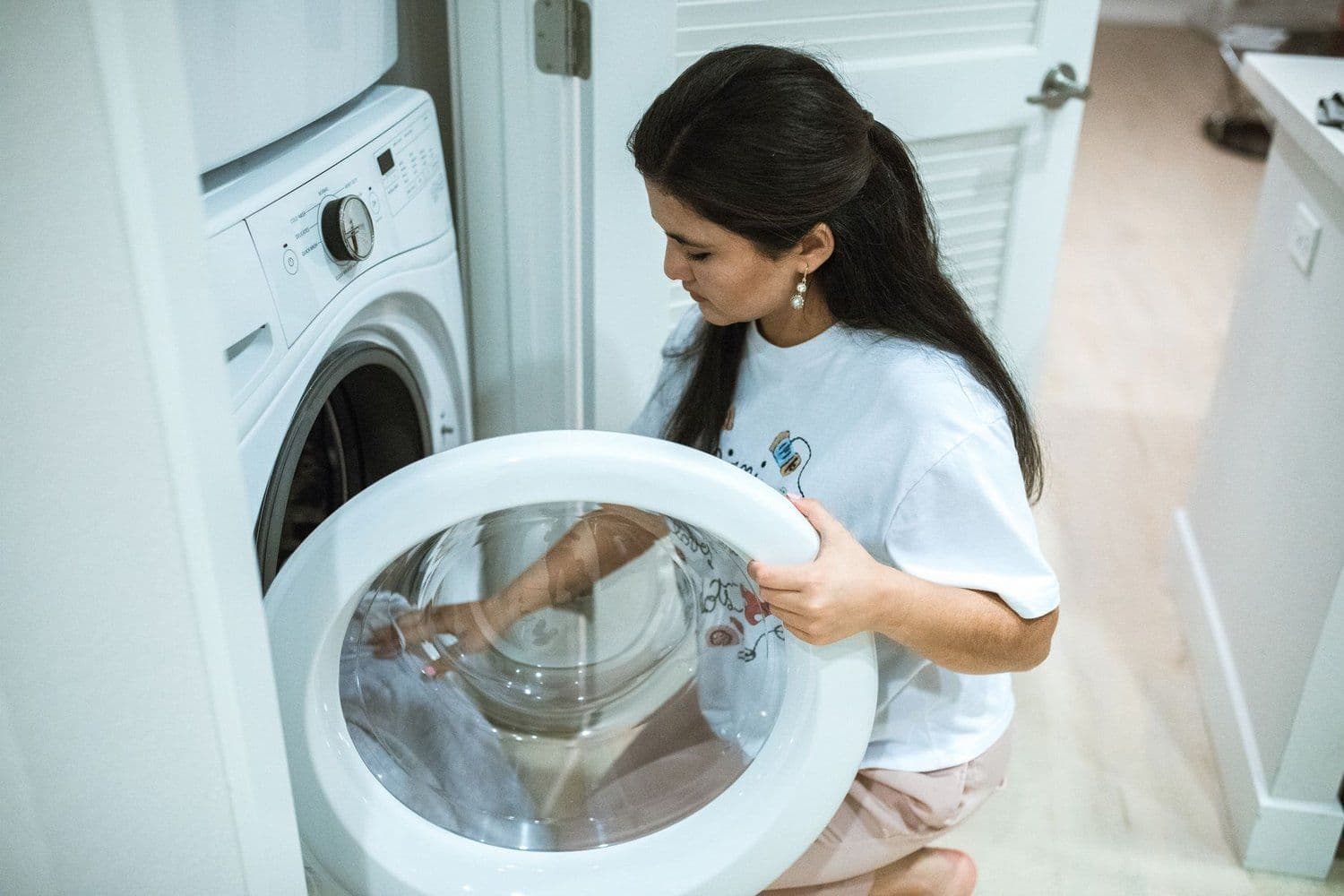
In a busy Audie Murphy Ranch household, the washing machine rarely gets a day off. School uniforms, sports kit, towels, bedding, and the steady stream of everyday laundry add up to a lot of cycles. Most homes in the neighbourhood were built from the mid-2010s onward with Samsung or LG front-load washers, and those machines handle the workload well, right up until the drum bearings begin to wear.
Bearing failure is the most important front-load washer problem to catch early. Caught in its first weeks, it is a contained repair. Left alone, it can take the whole machine with it.
This guide explains why family laundry wears bearings faster, what early and late bearing failure sound like, how a technician tells a bearing apart from other noisy faults, and how to weigh the cost of repair against a new washer.
Why family demographic accelerates bearing wear
A front-load washer's drum spins on a pair of bearings at the back of the outer tub, protected from water by a rear seal. Every cycle loads those bearings, and the heaviest load comes during the high-speed spin, when a drum full of wet laundry is turning fast. Bearings are designed for a long life, but that life is measured in cycles and loads, not years.
That is why the timeline shifts in family homes. Front-load bearings typically begin to fail around years 6 to 8 with average use. In Audie Murphy Ranch, where heavy laundry use is the norm, failures commonly arrive around years 5 to 7.
Several family laundry habits add to the strain:
- More cycles. Daily or near-daily washing simply uses up bearing life faster.
- Heavy and overloaded drums. Towels, jeans, and bedding hold a lot of water, and an overfilled drum is a heavier drum.
- Unbalanced loads. A single comforter, a bath mat, or a pile of soaked sports kit can bunch to one side. The washer tries to rebalance, but an off-centre load at spin speed puts uneven force on the bearings.
- A closed door between washes. Trapped moisture is hard on the rear seal and the drum spider that supports the drum.
Menifee's water adds one more factor. EMWD water runs at 130 to 170 ppm hardness, and scale accumulation inside front-load drum bearings accelerates their failure. Once the rear seal begins to let water through, the bearings lose their grease, start to rust, and the noise begins.
None of this means you need to wash less. It means new noises from a family front-loader deserve attention sooner rather than later.
Early vs late bearing failure sounds
Bearing failure has a recognisable progression, and learning it is the single most useful thing you can do to protect your washer.
Early stage. The first sign is usually a low rumble or hum during the high-speed spin that was not there before. It often rises in pitch as the drum speeds up and fades as it slows. During the wash and rinse phases, the machine may sound completely normal, which is why early bearing noise is easy to dismiss as a heavy load. If you notice it two or three times in a row, on loads of different sizes, take it seriously.
Middle stage. The rumble becomes a distinct grinding or roaring sound during spin, loud enough to hear from another room. You may also hear it as the drum coasts to a stop at the end of the cycle. At this point the bearing is clearly failing and the sound will keep getting worse. This is still usually a repairable situation, but the window is closing.
Late stage. The grinding is present during washing as well as spinning. The drum may knock or clunk, and with the machine off, the drum feels loose when you lift its front edge. You may notice rust-coloured streaks or residue around the back of the tub, or water where the rear seal has failed. The clearest warning sign is a drum that visibly wobbles while it turns.
That wobble matters because of what it usually means. Once a bearing has deteriorated that far, moisture has typically been reaching the drum spider, the metal frame that connects the drum to the drive shaft, and the spider corrodes. A corroded spider turns a bearing repair into a much larger job, and the machine often becomes not worth repairing.
The practical rule is simple. Book a diagnostic within a few weeks of first noticing the grinding sound. Repair at that stage preserves the drum, while waiting until the drum wobbles usually costs you the washer.
Diagnostic approach: distinguishing bearing from other faults
Not every noisy front-loader has bad bearings, and a correct diagnosis matters because the other causes are often far cheaper. Several faults can sound similar to an untrained ear:
- Drain pump problems. A coin, hair clip, or small sock caught in the drain pump makes a rattling or grinding sound, but mostly while the machine drains rather than throughout the spin. Drain pump replacement runs $180 to $280, and sometimes the pump only needs clearing.
- Worn shock absorbers or dampers. These cause banging, thumping, or a washer that walks across the floor during spin, rather than a steady grind.
- Objects between the drum and tub. A bra underwire or a coin trapped between the drum and the outer tub produces a scraping or ticking sound with each rotation.
- Levelling problems. A washer that is not level can vibrate and rattle in ways that mimic more serious faults.
A thorough diagnostic works through these systematically. With the machine empty and off, the drum is rotated by hand to feel for roughness and listen for the telltale rumble of a worn bearing. The front edge of the drum is lifted to check for play. The rear seal area is checked for water or rust traces, the pump filter is inspected, and the suspension and levelling are checked. Samsung and LG front-loaders also store fault information, and reading their error codes accurately requires manufacturer-specific diagnostic tools, which are maintained for both brands.
The diagnostic takes 20 to 40 minutes and ends with a flat-rate quote before any work begins. If the bearings are the problem, the quote also tells you whether the drum spider is still sound, which is what decides whether repair is sensible.
There are a few checks you can do before calling. Make sure the washer is level, clean the drain pump filter if your model has an accessible one, and turn the empty drum slowly by hand. A smooth, quiet rotation suggests the problem may lie elsewhere. A gritty feel or rumbling sound points toward the bearings.
Repair cost vs replacement calculation
When drum bearings are caught early, replacement typically costs $400 to $800. It is a substantial job, since the outer tub has to come apart to reach the bearings and the rear seal, and it usually means two visits: the diagnostic first, then a return visit once the ordered parts arrive. The $89 diagnostic is waived when you go ahead with the repair, and the same technician who diagnoses the fault comes back to complete it.
The comparison is a new washer. A basic front-load washer costs $700 to $1,200, a mid-range Samsung front-loader $1,000 to $1,600, and a mid-range LG front-loader $1,000 to $1,700. Against those figures, the decision usually depends on the washer's age:
- Under 5 years old. Repair. The rest of the machine has plenty of life left.
- 5 to 8 years old. Borderline, and this is where most Audie Murphy Ranch bearing failures land. A $500 repair is usually still worth doing. The deciding factors are the exact quote, the washer's warranty and repair history, and whether it is paired with a matched dryer. If the washer is part of an integrated tower unit, or you like having a matched pair, keeping the washer has extra value.
- Over 8 years old with multiple failures. Usually replace. A new bearing will not help if the control board, motor, or pump is also on its way out.
One condition overrides all of these: a corroded drum spider. If the spider has been damaged, the machine is often not worth repairing at any age, which is why acting early matters so much.
Every repair carries a 90-day parts and labour warranty. If the same fault returns within 90 days, the return visit is at no charge.
For more on front-load and top-load faults, see the washer repair page, and for neighbourhood-specific service details, the Audie Murphy Ranch appliance repair page. If your washer has started to rumble, call Jim Patterson on (951) 585-5320 or book through the contact page. Same-day service is available for calls before 11 am.