If your dishwasher won’t fill, the cause is usually one of six things: a shutoff valve that isn’t fully open or a kinked supply line, a door that isn’t registering as latched, a float held up by debris, water left in the tub by a clogged drain, a failed inlet valve or switch, or, less often, a control fault.
The first four causes cost nothing to check. The last two need panels off and a meter, which is where safety and cost start to matter. So the guide runs in order of effort and risk: free checks first, tests only if you’re comfortable, and a clear point to stop.
Before you remove any panel: switch off the dishwasher’s breaker (and unplug it too if it has a plug; many are hardwired). Close its water shutoff. Confirm the controls are dead before touching anything. Anything involving household wiring, outlets or the breaker panel is electrician territory. Stop and call if you smell burning, see water on the floor, or aren’t sure.
What you see and hear
- Silent, display dead: likely power, the door latch or the control, not yet a fill fault. Check the breaker and close the door firmly.
- Hums or clicks, no water: the valve may not be opening, the supply may be restricted, or a float may be holding the fill off.
- Fills slowly or stops short: look for a partly closed shutoff, a kinked line or a clogged inlet screen.
- Water already in the tub: a drain problem is blocking the next fill. Clean the filter first.
- Water appears, then disappears: the drain hose may be siphoning. See the look-alikes below.
- Water enters when the machine is off: the inlet valve may be stuck open. Close the shutoff now and call.
Free checks first (no tools, no panels)
Work through these in order and run a short cycle after each change.
- Open the shutoff valve fully. It’s usually under the sink. A knob turns counter-clockwise until it stops, and a lever is open when it lines up with the pipe. Check that the kitchen faucet runs normally too. Many dishwashers fill from the hot line, so your manual will say which supply it uses.
- Latch the door properly. A door that doesn’t latch blocks the fill, and cutlery or a rack sticking out can stop it closing. On Whirlpool-built models, opening the door mid-cycle or losing power makes the Start/Resume light flash. Whirlpool says to press it and close the door within 3 seconds.
- Look for standing water and clean the filter. Water left in the tub can keep the float raised, so the machine thinks it’s full. Remove the filter as your manual describes and clear it.
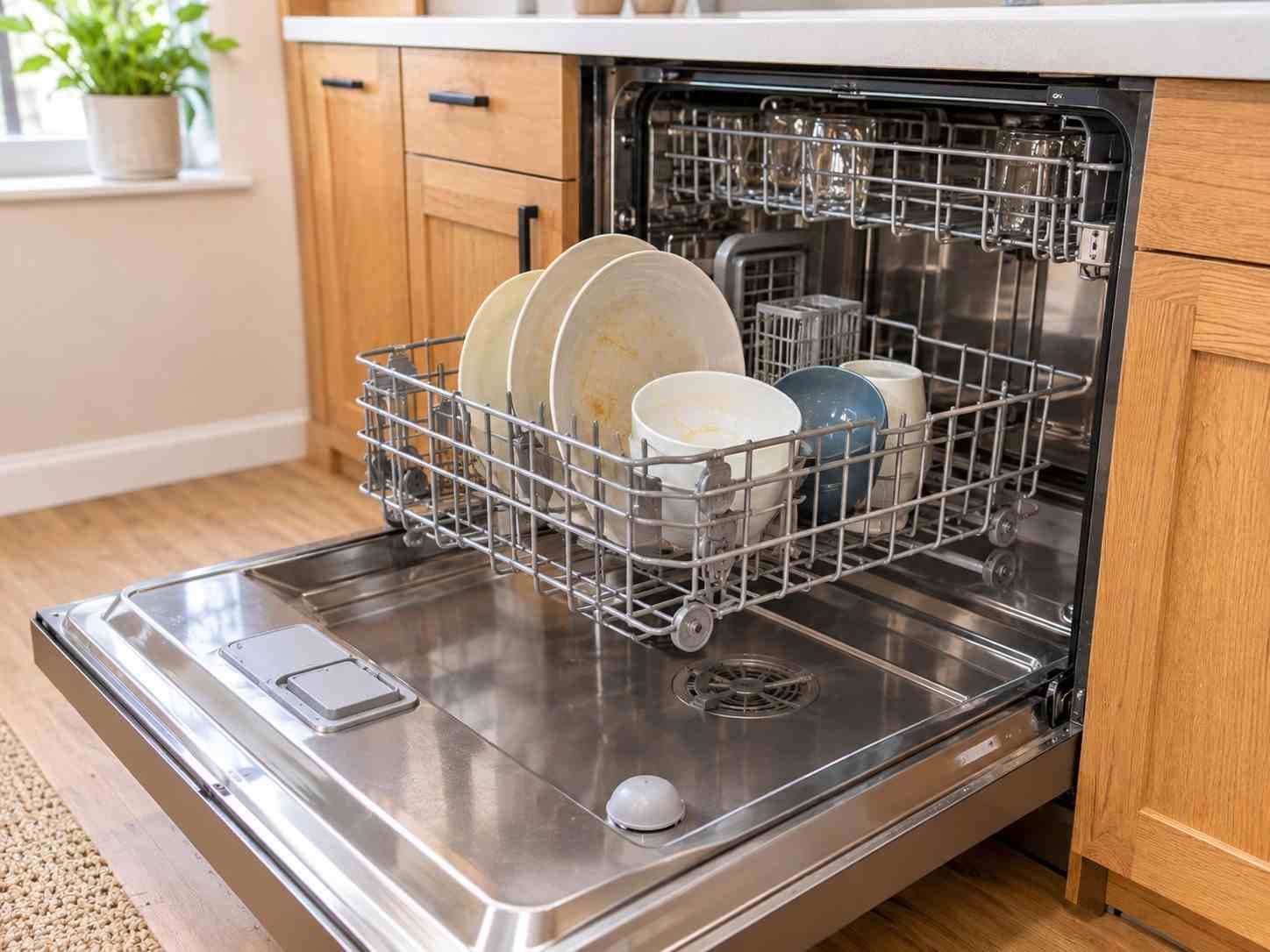
- Free the float. Pull out the bottom rack. The small dome in a front corner should lift and drop freely. Debris and sticky residue can hold it up. Don’t force it.
- Check the supply line under the sink and behind the unit for a sharp kink.
- Newly installed or just pushed back into place? Confirm the line is connected, the shutoff is open and nothing is pinched. LG’s own troubleshooting starts with newly installed units and kinked water lines.
- Reset the power. Breaker off for a few minutes, then back on. If your manual describes a reset sequence, use that instead.
If it fills now, you’re done. If not, read on before removing anything.
Is it really a fill problem? Three look-alikes
- Won’t fill: nothing enters. That’s what this guide covers.
- Fills, then the water vanishes: the drain hose may be siphoning. Whirlpool says the hose should connect above the house trap and at least 20 inches above the floor.
- Won’t stop filling, or fills when off: the valve is stuck open. Close the shutoff and call. The valve screen note in the tests section explains why.
A slow or blocked garbage disposal or drain line can also leave water in the tub, which brings you back to step 3.
How the fill system works
Before water enters, the control checks that the door switch reads closed. If it does, current is sent through the float switch to the inlet valve.
Power → door switch (reads closed) → control → float switch (reads “not full”) → inlet valve opens → water enters
A break anywhere in that chain stops the fill. That’s why a bad switch can look exactly like a bad valve, and why replacing the most expensive-sounding part first often wastes money.
Not every model works this way. Some rely on level sensing or fill timing instead. LG, for example, reports its IE code when the water level hasn’t risen enough after 10 minutes of filling.
Treat the chain above as the typical case and your manual as the authority. Your model number, usually on a label on the door edge or tub rim, will get you the right manual.
Tests that need power and water off
These involve removing the lower front panel and, on some models, separating the door panels. Do them only if you’re comfortable.
Prepare
- Breaker off, controls confirmed dead.
- Shutoff closed, with a towel and a shallow container ready.
- The line can hold hot water, so open fittings slowly.
- Remove the lower front panel. The inlet valve is usually behind it where the supply connects, and the float switch sits under the float.
Inspect first. Look for loose connectors and damaged wires on each part before testing anything. Reconnect what’s loose, then re-test the machine.
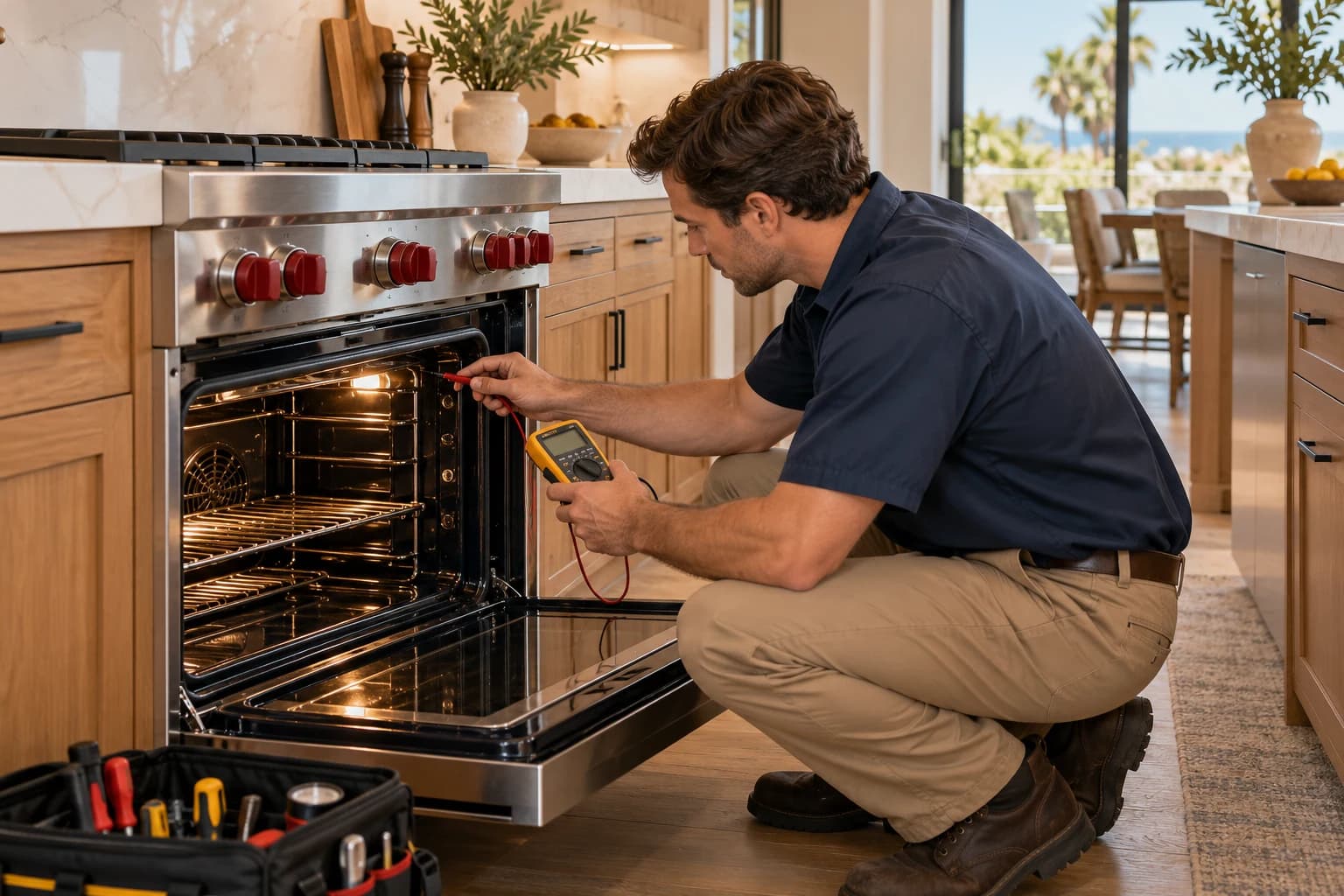
Then test with a multimeter. Sears PartsDirect’s troubleshooting guide walks through the same sequence. Disconnect the wires from each part, then check:
- Door switch (in the latch assembly): it should show continuity, near 0 ohms, when pressed. An open circuit means replace the latch assembly.
- Float switch (under the float): a working switch shows continuity. An open circuit means replace it.
- Inlet valve (where the supply connects): an open circuit means replace it.
Readings vary by brand and model. Sears cites around 1,400 ohms for a Whirlpool-built valve, and other makes can read differently. Use your model’s service sheet. A good reading also doesn’t prove a part works under load.
The valve screen. With the supply line disconnected over your container, look for a clogged inlet screen. Sources differ on the fix. Samsung’s support page lists a clogged filter on the supply valve and says to clean it.
Sears says to replace the water valve if its screen is clogged, because debris can reach the valve body and make it stick open, which can flood a kitchen. Follow your manual. If it doesn’t describe a cleanable filter, Sears’ rule is to replace.
The supply itself. Hold the disconnected line in the container and briefly open the shutoff. No flow means a plumbing problem, not an appliance fault.
Where to stop
- The door switch, float switch and valve test fine and the wiring is secure. The cause may be the control or the wiring, which is a job for a dishwasher repair technician.
- You can’t find the expected reading for your model.
- A connector is burnt or corroded.
- The unit is hardwired and you’d need to go beyond its own panel.
- Water is on the floor or under the unit.
- Anything would need testing with power on.
- You’d rather not use a meter. That’s a sensible limit, not a failure.
Humming or clicking but no water
A buzz behind the lower panel as the fill starts can mean the valve is being powered but isn’t passing water. A supply restriction or a float switch can look the same.
A steady hum from the pump with an empty tub is different, because the machine is trying to run dry. If that’s what you hear, cancel the cycle rather than letting it run.
You replaced a part and it still won’t fill
Because the fill path is a chain, replacing one link doesn’t prove it was the broken one. Before buying a second part:
- Confirm water actually reaches the valve (the supply test above).
- Re-check every connector.
- Test the door and float circuit.
- Leave the control for last.
Error codes that point to a fill problem
Newer homes, such as those in Heritage Lake, often have electronic controls that show a code. Codes are model-specific, so confirm against your manual, and fix the cause before clearing a code or it will return.
- Samsung 4C or 4E: Samsung describes a water supply issue, including a closed, defective or clogged supply valve, a bent hose or a control fault.
- LG IE: the water level didn’t rise enough within 10 minutes. Check the supply valve and line first.
- Bosch E15: water was detected in the base, so leak protection is active. This is a leak code, not a fill fault. Bosch’s US page says to turn off the water inflow and contact Bosch support.
- Other brands, and other Bosch codes: use your manual’s code chart. Published lists disagree with each other.
Hard water in Menifee: slow fills before no fills
Most Menifee homes, including Sun City and Quail Valley, are on Eastern Municipal Water District (EMWD) water. Confirm on your bill.
In hard-water areas, mineral deposits can collect in small screens and passages, such as the one at the valve inlet. As a rule of thumb (our reasoning, not a published statistic), a fill that has been getting slower for weeks points more toward restriction than one that stopped overnight. We check for scale on every dishwasher visit.
How hard is the water? EMWD’s 2023 water quality report reports hardness in grains per gallon (1 grain equals 17.1 ppm). Source averages run from roughly 5 to 13, and the report classes 8.8 to 17.5 as hard. It varies by source, so check the report for your area rather than relying on one number.
Is it worth repairing?
Our typical prices:
- Diagnostic visit: $89, waived if you go ahead with the repair.
- Standard dishwasher repair: $180–$450.
- Door latch switch: $80–$150.
- Control board: $250–$500.
- New dishwasher: roughly $900–$1,600.
These are indicative, and a flat-rate quote follows the diagnosis. As an illustration, a $250 repair is about 16% to 28% of the cost of replacing the machine ($250 ÷ $1,600 to $250 ÷ $900), so a single clean fault is often worth fixing.
Our general guidance is that one failure on an older unit is usually worth repairing, while several failures at once on a 15-plus-year-old machine often favour replacement. Check for warranty cover first. For older models, our vintage appliance repair page covers parts availability.
When to call, and what a visit involves
Call if:
- The free checks and safe tests all pass and it still won’t fill.
- It hums or clicks and takes no water after the free checks.
- There is any leak, overfill, or fill while the machine is off.
- A part needs replacing and you’d rather not do it.
On a visit we diagnose in about 20 to 40 minutes, give a flat-rate quote before any work, and back repairs with a 90-day parts and labour warranty. The same technician handles the diagnostic and the repair.
We serve Menifee, Quail Valley, Wildomar and Perris, including newer neighbourhoods such as Audie Murphy Ranch. Same-day service is available for calls before 11 am, Monday to Saturday.
If you’d like us to take a look, book a visit through our contact page. And if you’ve found a kink, a stuck float or a closed valve, you may not need us at all.