
A GE refrigerator that has kept a Sun City kitchen running for 15, 20, or even 30 years usually gives some warning before it fails. The milk is not quite as cold as it used to be, the compressor seems to run all the time, or the whole appliance goes quiet and warm while the light still comes on. On older GE models, one of the most common causes of these symptoms is a failing thermostat, also called the cold control or temperature control.
Thermostat replacement is one of the more affordable refrigerator repairs, and on older GE models the parts are usually still obtainable. It is also a part that gets replaced unnecessarily, because several other faults look just like a bad thermostat from the outside.
This guide explains what a failing GE refrigerator thermostat looks like, how it is tested before any part is ordered, what parts are available for GE refrigerators 15 to 30 years old, what the replacement involves, and when the real problem lies somewhere else.
Symptoms of a failing GE refrigerator thermostat
On most older GE refrigerators, the thermostat is a mechanical switch connected to a thin capillary tube. The tube contains a gas that expands and contracts with temperature. As the compartment warms, the pressure rises and closes a set of electrical contacts, which starts the compressor and fans. When the compartment cools to the set point, the contacts open again. That simple cycle is what keeps the temperature steady.
When the thermostat starts to fail, it usually does so in one of a few recognisable ways.
The refrigerator runs warm. The contacts are not closing when they should, or the sensing tube has lost some of its charge, so the compressor runs too little. Turning the dial colder makes little or no difference.
The compressor never switches off. The contacts have stuck closed. The refrigerator gets colder and colder, items at the back of the fresh food section freeze, and the compressor runs continuously.
The refrigerator goes silent and warm. The contacts have stuck open. The interior light still works because it has its own circuit, but the compressor and fans never start.
Erratic temperatures. Worn contacts can make the cycle unpredictable, with the compressor starting and stopping more often than it should, or temperatures drifting from day to day.
The dial has no effect. On a healthy mechanical thermostat, turning the dial from off toward a colder setting produces a distinct click. If there is no click and no change in the refrigerator's behaviour, the thermostat is a likely suspect.
Any one of these symptoms justifies a closer look. None of them, on its own, proves the thermostat has failed.
Testing the thermostat before ordering parts
The most expensive mistake with a suspected thermostat is buying one before confirming it is the problem. A few simple checks narrow things down.
Check the setting. Dials get bumped during cleaning or while loading groceries. Make sure the control is at a normal middle setting before assuming anything has failed.
Measure the actual temperature. Place an appliance thermometer in a glass of water on a middle shelf and read it the next morning. That gives a far more reliable picture than how cold the food feels.
Listen for the click. With the refrigerator plugged in, turn the dial from off to a cold setting. A click followed by the compressor starting suggests the contacts are switching. No click, or a click with no compressor, points toward the thermostat or the compressor's start components.
Look at the rest of the cooling system. Check that the condenser coils are not coated in dust, that the condenser fan near the compressor turns when the compressor runs, and that you can hear the evaporator fan in the freezer. Heavy frost on the freezer's back panel suggests a defrost problem rather than a thermostat problem.
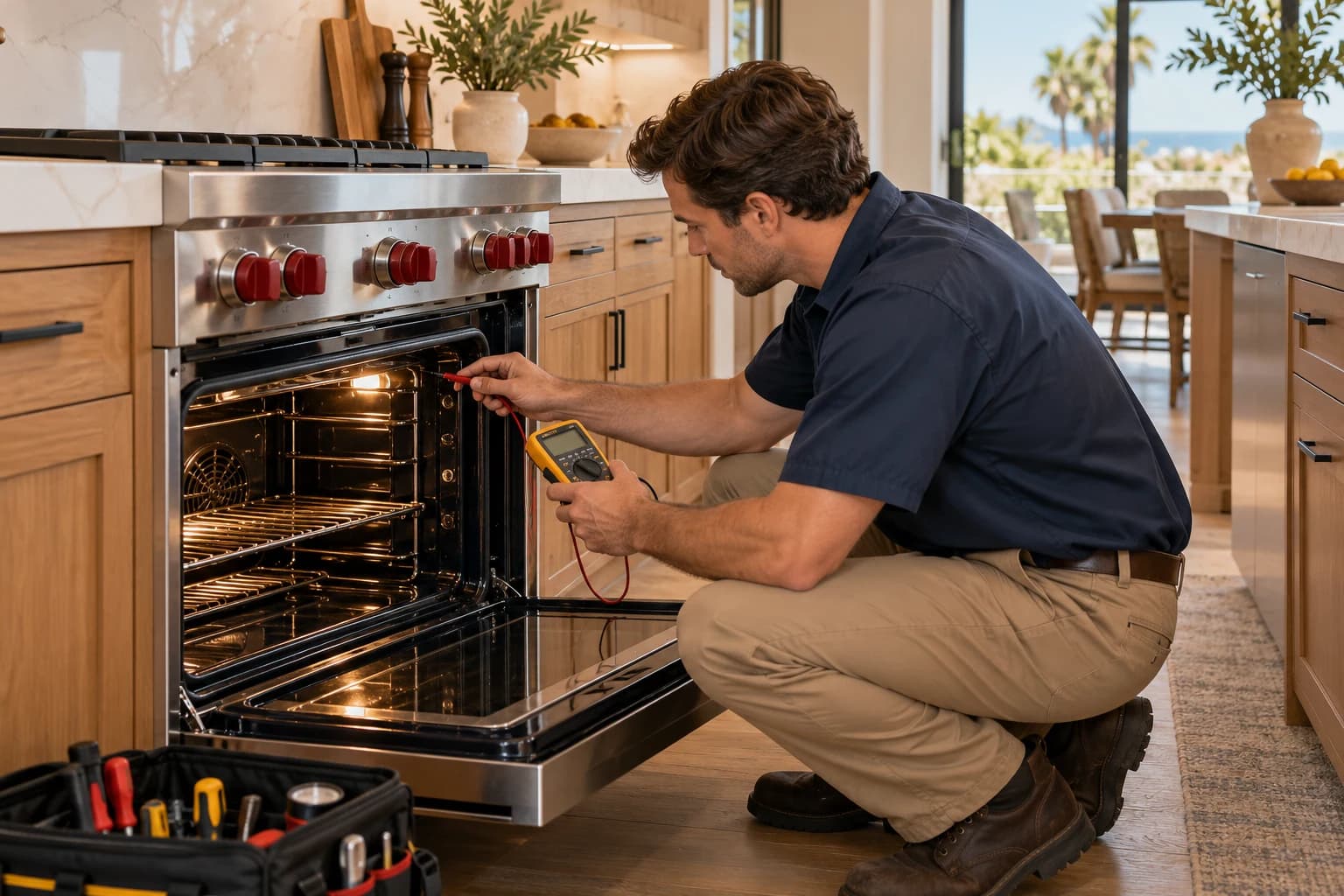
Past this point, testing involves removing the control housing and checking the thermostat's contacts with a meter as the temperature changes, and checking the compressor circuit at the same time. That is diagnostic work, and it should only ever be done with the refrigerator unplugged. A professional diagnostic takes 20 to 40 minutes and ends with a flat-rate quote. The $89 diagnostic fee is waived when you go ahead with the repair.
Thermostat parts for GE refrigerators 15-30 years old
For GE refrigerators in this age range, thermostat parts are generally still available, and vintage GE parts availability is comparable to vintage Whirlpool. There are two main routes.
GE authorised distributor network. Current GE parts, including many thermostats that have been superseded by updated part numbers, come through the authorised network. Standard components typically arrive in 24 to 72 hours. A superseded part may look slightly different from the original but is designed to fit the older refrigerator.
Specialist vintage suppliers. For older models where the original part has dropped out of current production, specialist suppliers often hold legacy stock or cross-referenced equivalents. Vintage GE parts through these suppliers typically take 3 to 7 business days.
The right part depends on the exact model number, usually found on a label inside the fresh food compartment. Thermostats differ in capillary tube length, terminal layout, mounting, and temperature range, so a part that looks similar is not always interchangeable.
It is also worth knowing that later GE models moved to electronic temperature control, using sensors and a control board instead of a mechanical thermostat. On those refrigerators, a "thermostat" fault usually means a sensor or board fault, which is diagnosed and priced differently.
Thermostat replacement on older GE refrigerators typically runs $120 to $220.
Replacement procedure overview
On a typical older GE refrigerator, the replacement follows a consistent sequence. This overview explains what is involved so you know what to expect from a service visit.
- Disconnect power. The refrigerator is unplugged before any cover is removed.
- Remove the control housing. The thermostat usually sits in a housing at the top or back of the fresh food compartment, often combined with the light. Shelves may need to come out for access.
- Note the capillary tube routing. Where the sensing end of the tube sits, and how it is clipped in place, determines what temperature the thermostat actually reads. The new tube needs to sit in the same position.
- Transfer the wiring. Each wire is noted and moved to the matching terminal on the new thermostat.
- Fit and reassemble. The new thermostat is mounted, the tube is routed as before, and the housing goes back on.
- Test across cycles. With power restored, the dial is checked for a clean click, the compressor and fans are confirmed to start, and the refrigerator is set to a normal position. It needs time to stabilise, so temperatures are checked across several cycles rather than minutes after the repair.
While the housing is open, it makes sense to check the condenser coils, fans, and door seals as well, so the new thermostat is not working against another developing fault. Every repair carries a 90-day parts and labour warranty.
When thermostat replacement is not the right fix
Several common faults produce the same symptoms as a failing thermostat, and on a refrigerator that runs warm, the thermostat is often not the culprit.
- Dusty condenser coils. Menifee's dry summers and inland dust coat coils quickly, and the refrigerator cannot shed heat. A coil cleaning costs $95 with the diagnostic waived.
- Evaporator fan motor. If the freezer is cold but the fresh food section is warm, the fan that moves cold air between compartments may be failing. Replacement typically runs $150 to $250.
- Condenser fan motor. A common repair on older GE refrigerators, since a fan that has stopped turning leaves the compressor unable to shed heat. Replacement typically runs $150 to $250.
- Defrost system. A failed defrost timer ($120 to $200) or defrost heater or defrost thermostat ($80 to $200) lets ice build up on the evaporator and block airflow. The defrost thermostat is a separate part from the temperature control.
- Door seal. A worn gasket lets cold air escape and keeps the compressor running. Replacement on a standard side-by-side runs around $180.
- Sealed system or compressor. If the compressor runs but nothing gets cold, the problem may be a refrigerant leak or a failing compressor. On a refrigerator 20 years old or more, that usually favours replacement.
If the diagnostic shows your refrigerator is not economically repairable and you decide not to proceed, Sun City residents receive a 50 percent diagnostic discount, paying $44.50 instead of $89, along with honest replacement guidance.
For more on older GE models, see our GE appliance repair page, or our general refrigerator repair guide. To book a diagnostic with Jim Patterson, call (951) 585-5320. Same-day service is available for calls received before 11 am, Monday to Saturday.