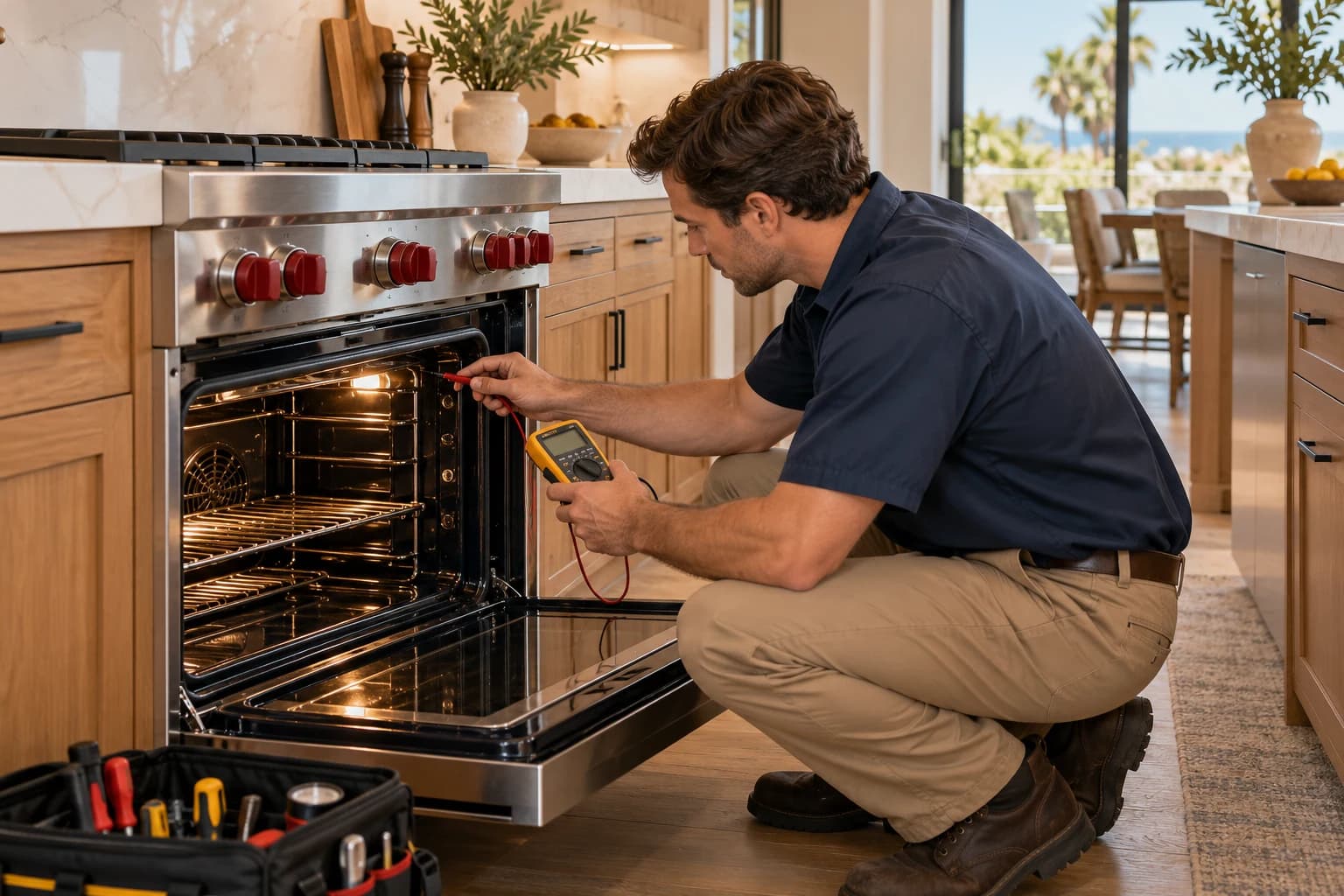

Walk into most Sun City kitchens and you will find a story told in appliances. An original range that has cooked thousands of meals, a refrigerator swapped in some years ago, perhaps a newer dishwasher or a microwave that replaced one that finally gave out. Mixed kitchens like these are normal here, and they reflect something sensible: households that keep what works and replace what does not.
At some point, though, many households start thinking about modernising, whether because of a renovation, a run of repairs, or simply wanting a kitchen that is easier to live with. That is when the questions start. Which appliances are worth keeping? Is a smart refrigerator worth it? Will a new range even fit?
This guide works through those questions from the repair side, drawing on Jim Patterson's 22 years of appliance service experience and his work with Sun City households since 2016. The aim is not to talk you into a new kitchen or out of one, but to help you spend wisely on the parts that matter.
What to replace vs what to keep
The starting point is that modernising does not have to mean replacing everything at once. Some older appliances are better than anything you could buy to replace them, and some are genuinely past their best.
Appliances usually worth keeping:
- Electric coil ranges and cooktops. Coil elements cost $80 to $150 each to replace, infinite switches $80 to $180, and the parts remain widely available. A coil range that heats evenly can run for many more years.
- Vintage top-load washers. Motor couplings, timers, and inlet valves are inexpensive repairs on older Whirlpool, Maytag, and Kenmore machines, which often run reliably for another five years or more after them.
- Chest freezers. They are mechanically simple and typically fail less often than upright freezers. A $150 to $250 thermostat replacement on a reliable chest freezer is usually a better decision than replacing it.
- Over-the-range microwaves built into older cabinetry. A replacement may need cabinet modification or a different exhaust route, so repairing the existing unit is often worth it to preserve the installation.
Appliances that are reasonable to replace:
- Refrigerators with a sealed system or compressor failure at 20 or more years old. Repair is possible, but the rest of the sealed system is usually near the end of its life too.
- Any appliance with multiple simultaneous failures. Two or three failures at once on a 20-year-old appliance usually means it is approaching the end of its life.
- Older gas ranges with safety-relevant failures. On some ranges over 25 years old, the original design safety margins are outdated by current standards. It is rare, but it is a good reason to replace.
- Basic countertop microwaves. At $100 to $300 to replace, replacement often makes more sense than repair.
Then there is the appliance that works perfectly well but no longer suits you. A refrigerator that is awkward to reach into, or a range with controls you find hard to read, is a fair candidate for replacement even if it is running fine. Wanting a new appliance is a legitimate decision, and it deserves honest guidance rather than a lecture about repairability.
A sensible order is to replace what is failing or hard to use first, keep what works, and revisit the rest as each appliance reaches its own repair-or-replace moment.
Smart appliances vs simple appliances for 55+ households
There is no reason to assume a 55+ household does not want smart features. Plenty of people over 55 are entirely at home with smartphones and tablets. The better question is whether the features will make daily life easier, and whether that is worth the extra complexity.
Smart appliances do offer real conveniences. A phone alert when the refrigerator door has been left open, a notification that the laundry has finished, or the ability to check whether the oven is off after leaving the house can all give genuine peace of mind. Touchscreen models such as Samsung's Family Hub refrigerators put a screen and apps on the door itself.
The trade-off is that every smart feature adds electronics that can fail. Control boards are among the more expensive modern repairs, typically $250 to $450 on a washer and $300 to $500 on a Samsung range. Connectivity problems are also common, and they often trace back to the household's Wi-Fi setup rather than the appliance itself, which can be frustrating to sort out. Servicing smart appliances also requires manufacturer-specific diagnostic tools. Jim maintains them and is a Samsung Certified Technician and LG Pro Certified, so Samsung appliance repair and LG service are fully supported, but it is still worth knowing the repairs tend to cost more.
For many households, the best choice sits in between: a modern, efficient appliance with simple, clear controls. When you compare models, look for:
- Physical knobs or clearly labelled buttons rather than touch panels with small icons.
- Large, high-contrast displays you can read from a normal standing position.
- Range controls you can reach without leaning over hot burners.
- A layout that suits how you move. A bottom-freezer refrigerator means bending for frozen food, while a side-by-side keeps both compartments at a comfortable height.
The same thinking applies to smaller appliances. Batch-feed garbage disposals, which are switched on by the stopper rather than a wall switch, are preferred in Sun City homes where the wall switch location makes single-handed operation awkward.
Fitting modern appliances into older Sun City kitchen footprints
A new appliance that does not fit is an expensive mistake, and older kitchens deserve particular care. Cabinetry, alcoves, and hookups were built around the appliances of their time, and modern models do not always follow the same dimensions.
Refrigerators. Measure the width, height, and depth of the opening, including any cabinet above it. Many modern refrigerators are larger than older models. Allow for the ventilation clearance listed in the installation instructions, and check that the doors can open fully next to walls, counters, or an adjoining cabinet. A door that cannot open past 90 degrees can stop crisper drawers from sliding out.
Water lines. If your new refrigerator has an ice maker or water dispenser and the old one did not, it will need a water supply line. Keep Menifee's water in mind here: EMWD water runs at 130 to 170 ppm hardness, which damages ice makers over time. An under-sink reverse osmosis filter dedicated to the refrigerator line, typically $500 to $900 installed, is worth considering at the same time.
Ranges and cooktops. Confirm the width of the existing opening and whether it is supplied with gas or electric. Switching fuel type is a significant job involving new gas or electrical work. If you are considering induction, remember that it only works with ferromagnetic cookware, meaning pans a magnet sticks to.
Dishwashers. The opening under the counter, along with the existing water, drain, and electrical connections, decides what will slide in easily.
Over-the-range microwaves. These are integrated with the cabinet above the range and the exhaust route. A replacement needs a matching unit or cabinet modification, which is why repairing a good existing unit is often the better choice.
Before you buy, measure twice and keep the old appliance's model number handy. It is usually on a sticker inside the door or on the back, and it helps when comparing dimensions.
Energy and water savings reality check
Modern appliances use significantly less energy than vintage equivalents, and households that prioritise energy efficiency do see a genuine benefit from replacement. It is still worth being realistic about where that benefit comes from.
The biggest gains are on appliances that never switch off. A refrigerator or freezer runs day and night, and older units lose efficiency as door gaskets harden and insulation ages. If you are replacing one appliance mainly for efficiency, the refrigerator is usually the one that makes the most difference. An old second refrigerator or freezer in a garage, working through Menifee's summer heat, is another good candidate.
Dishwashers and washers are more modest. Modern models use less water and energy per cycle, and efficient washers spin more water out of each load, which shortens drying time. But the savings scale with use. A one- or two-person household running a few loads a week will save far less than a large family, and it may take many years for those savings to cover the price of the new appliance.
Hard water matters here too. Modern appliances rely on small water passages, valves, and spray nozzles, and scale from EMWD water can erode the performance you paid for. Rinse aid in the dishwasher, a descaling cycle every three months, and a monthly hot cleaning cycle in the washer help protect that investment.
The honest conclusion is that energy efficiency is a good reason to choose a better model when you are already replacing an appliance, and a weaker reason to replace one that is working well. When you do shop, the yellow EnergyGuide label gives an estimated yearly operating cost that makes models easy to compare.
Working with Jim Patterson for continuity
Modernising a kitchen is easier when someone who knows your appliances is part of the conversation. Jim performs the diagnostic, the repair, and any follow-up himself, and if you are a returning Sun City customer, mentioning him by name means your service history is reviewed before the visit.
Before you buy anything, a repair-or-replace consultation is available for the diagnostic visit fee only, with an honest view on whether each appliance is worth repairing. If the diagnostic shows an appliance is not economically repairable and you decide not to proceed, Sun City residents pay $44.50 instead of the usual $89, and replacement guidance is provided at no charge. If you would like time to think, you can call back within 48 hours to schedule the repair at the same quoted price without paying for a second diagnostic.
After you modernise, the same continuity carries on. The vintage appliances you keep are serviced through vintage appliance repair, with specialist parts sourcing when the manufacturer no longer stocks them, and your new appliances are serviced by the same technician. That is the heart of Sun City appliance service: one technician who knows your whole kitchen.
To talk through your kitchen, call Jim on (951) 585-5320, Monday to Saturday from 8 am to 5 pm, or get in touch through the contact page. Every repair carries a 90-day parts and labour warranty.