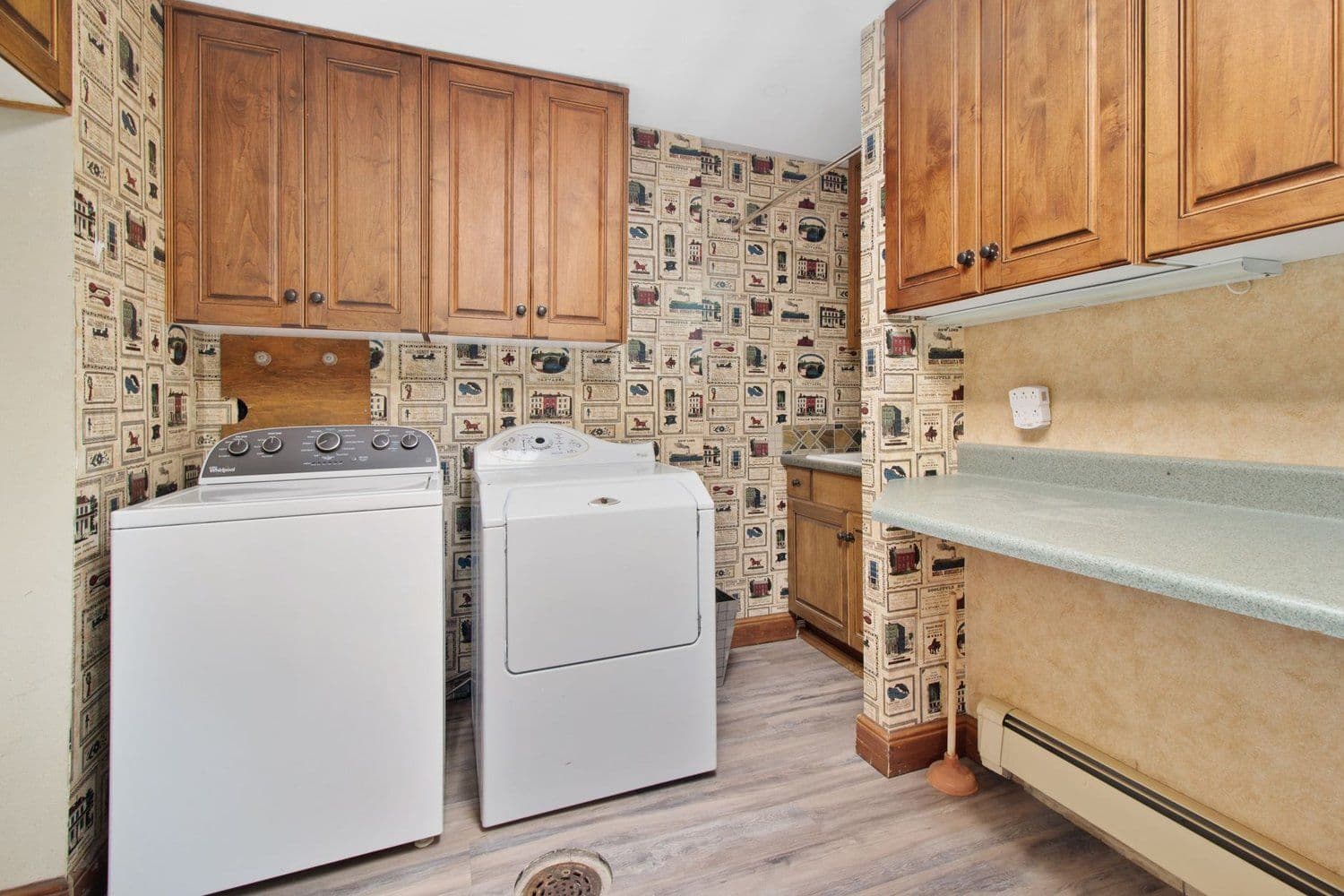
Many Sun City laundry rooms still have a Kenmore top-load washer that came with the house or was carried home from Sears decades ago, and a good number of those machines still handle a full week's washing without complaint. That surprises people who are used to hearing that a washer lasts ten or twelve years. It does not surprise anyone who has worked inside one of these machines, because the reasons they last become obvious the moment the cabinet comes off.
This guide explains why vintage Kenmore washers in Sun City have held up for 30 years and more, which three wear items account for most of the repairs that keep them running, how parts are found for a machine that is older than many of the companies now selling parts online, and how to tell when a well-loved washer has genuinely reached the end. It is written from the point of view of the technician who does this work every week, and it tries to be honest about both sides of the repair-or-replace question.
If you are reading this because your Kenmore has just stopped spinning or started leaking, the short version is this: most faults on these machines are repairable, the parts are usually still obtainable, and a diagnostic visit will tell you which category yours falls into before you spend anything on the repair itself.
The design philosophy behind 1970s-80s Kenmore washers
Kenmore was the Sears house brand, and Sears did not build its own washers. Manufacturing was contracted out, and for Kenmore top-load washers and dryers from the 1970s through the 1990s, that manufacturer was predominantly Whirlpool, with some Frigidaire builds along the way. In practical terms, most vintage Kenmore washers in Sun City are Whirlpool machines wearing a Sears badge, built on the same platforms and using the same parts as the Whirlpool washers sold alongside them.
Those platforms were designed around mechanical simplicity. A rotary timer opens and closes electrical contacts to run each stage of the cycle. A pressure switch senses the water level. A single drive motor powers both agitation and spin through a gear transmission, either by way of a belt on belt-drive machines or through a coupling on the direct-drive design. There is no circuit board deciding what the machine should do, no software, and no network of sensors that all have to agree before the tub will turn.
That simplicity helps longevity in two ways. First, there are fewer parts that can fail without warning. Mechanical components tend to wear gradually and announce themselves with noise, slowness, or a small leak before they quit, which gives a household time to call someone before a minor problem becomes a major one. Second, when something does fail, it is usually a single discrete part that can be removed and replaced on its own, rather than an integrated control module that takes several functions down with it.
Heavy-duty components were the design norm of the era, and expected service lives of 20 to 30 years or more were what these machines were built for. Current mid-range washers are typically engineered around a 10 to 12 year life. A Kenmore built to the older standard, in a household of one or two people, often runs far fewer loads a week than it was designed to handle, which is a large part of why so many are still going.
The three common wear items that extend Kenmore life another 5-10 years
Most repairs on a vintage Kenmore washer come down to a small number of parts that were designed to wear. Replacing one of them is not a sign that the machine is failing. These are the parts the engineers expected to be replaced at some point, and replacing them is exactly what keeps a 30-year-old washer working. A repair in the $200 range that extends the machine's life another 5 to 10 years is typically better value than a $700 new washer, and that is the reasoning behind keeping a sound Kenmore in service.
Motor coupling ($120 to $200)
On direct-drive Kenmore washers, the motor connects to the transmission through a small coupling made of two plastic drive forks and a rubber cushion between them. It is deliberately the weakest link in the drive train. If the tub is badly overloaded or something jams, the coupling breaks before the motor or transmission can be damaged.
The coupling is the single most common vintage Kenmore washer failure. The usual sign is a washer that fills and drains normally but will not agitate or spin, often with the motor clearly running and a rattling or grinding noise underneath. Sometimes small pieces of plastic turn up on the floor beneath the machine. Replacement typically runs $120 to $200, the part remains widely available, and when it is stocked on the vehicle it is a same-visit repair.
Transmission service ($180 to $400)
The transmission turns the motor's rotation into the back-and-forth motion of the agitator during the wash and then drives the basket during spin. On Whirlpool-built Kenmores it is a sturdy, sealed gearbox that rarely fails outright, but after decades it can develop oil leaks, seal failures, or worn internal parts. Signs include a dark, oily residue on the floor under the washer, an agitator that moves weakly or only in one direction, or a heavy knocking during agitation.
Transmission service typically runs $180 to $400 depending on the parts needed. The diagnostic establishes whether the fault is a seal or leak that can be dealt with, or something more serious inside the gearbox, and the quote reflects which one it is.
Belt replacement ($120 to $180)
Belt-drive Kenmore washers use a rubber drive belt between the motor and transmission. Over the years, belts stretch, glaze, and crack from heat and age. A worn belt usually shows up as a burning-rubber smell, a squeal as the spin starts, a tub that spins slowly or not at all, or weak agitation. Belt replacement typically runs $120 to $180, and standard belts remain readily available.
On a washer that is otherwise in good condition, any one of these three repairs is usually an easy decision in favour of repair.
Parts sourcing for 30+ year old Kenmore washers
The first question most Sun City residents ask about an old Kenmore is whether anyone still makes the parts. For common wear items the answer is generally yes, and those parts come from three places.
The Whirlpool authorised distributor network
Because most vintage Kenmore washers were built by Whirlpool, many of their parts are still manufactured under current Whirlpool part numbers. Couplings, belts, and a range of other components have been carried forward through decades of production, sometimes with updated materials, and an updated part number will often fit a much older machine. These parts are sourced through the Whirlpool authorised distributor network, the same channel used for current Whirlpool appliances.
Sears Parts Direct
Some Kenmore parts were catalogued under Sears listings rather than Whirlpool ones. Legacy Kenmore parts that are still in production can be sourced through Sears Parts Direct.
Specialist vintage appliance parts suppliers
When a part is no longer in current production, it may still exist in legacy inventory held by specialist vintage appliance parts suppliers. These suppliers stock and cross-reference older parts, and their inventory often reaches further back than any manufacturer's own stocking program. This is the channel that makes many 30-year-old repairs possible, and it is one that a technician who mostly works on newer appliances may never have needed to use.
Why the model number comes first
None of these channels can be used reliably without the correct model number. Kenmore model numbers begin with a three-digit prefix that identifies who actually built the appliance. A prefix of 110. means the machine was built by Whirlpool, which points parts sourcing toward the Whirlpool network and the parts shared with Whirlpool washers of the same era. Other prefixes lead elsewhere. A 253. prefix, for example, indicates Frigidaire, and parts for those machines follow a different path.
On a Kenmore washer, the model number is usually on a metal identification plate inside the top lid or on the back of the cabinet. If you can read it to us when you call, parts availability can be checked before the visit, which shortens the whole job.
Typical parts delivery runs 3 to 10 business days depending on the source. Availability is always verified before a repair is quoted, so you will know where the part is coming from and roughly when it will arrive before you commit to anything. For more on this side of the work, see our page on Kenmore vintage appliance service, and for the Whirlpool-built machines specifically, our Whirlpool appliance repair page.
When vintage Kenmore is no longer worth repairing
Not every old Kenmore should be saved, and it would not be honest to suggest otherwise. There are three situations where the economics usually turn against repair.
Multiple simultaneous failures
A single broken coupling on a sound machine is routine. A broken coupling together with a leaking transmission, a worn timer, and a badly corroded outer tub is a different situation. When two or three significant components fail at once on a washer 30 years old or more, it usually means the machine as a whole has reached the end of its working life, and repairing one part at a time tends to lead straight to the next call.
Transmission replacement economics
Servicing a transmission for a leak or a failed seal is one thing. A transmission that has failed internally and needs full replacement is another. On a washer 20 years old or more, a transmission failure often comes ahead of other component failures, and the combined cost starts to approach the point where a new washer is the better use of the money. Every case is assessed on its own, but this is where the recommendation most often shifts toward replacement.
Parts no longer available
Occasionally a specific part for a specific model simply cannot be found through any of the three channels. When a transmission or other essential part is no longer available, the machine is not repairable, however good its condition otherwise. If that happens, you will be told plainly, and the options will be talked through with you.
It is also fair to say that modern washers use significantly less energy than 1970s and 1980s equivalents. A household that puts efficiency first may reasonably decide to replace a washer that still works, and that is a legitimate choice. This service does not push repair when replacement is the better decision, and it does not push replacement when repair is the better decision.
Jim Patterson's Sun City vintage appliance service
Jim Patterson has 22 years of appliance service experience and has been the technician on record for many Sun City households since 2016. He spent nine years as the primary Sun City technician for a Hemet-based appliance service, and when that company was sold to a larger operator that could no longer commit to same-technician follow-ups, he founded this business in 2025 to keep those working relationships going.
That continuity is the practical centre of the service. Jim performs the diagnostic, the parts sourcing, the repair, and any follow-up. For returning customers, he already knows the appliance history, so a visit can begin with the problem rather than with "what model do you have?" If you have used Jim before, mention him by name when you call and your continuity records will be reviewed before the visit.
The diagnostic is $89 and is waived when you go ahead with the repair. Every vintage Kenmore call includes model and manufacturer identification, parts availability verification before any quote, a realistic assessment of the machine's remaining service life, and honest guidance on repair versus replacement. If Jim determines that your washer is not economically repairable and you decide not to proceed with any work, Sun City residents receive a 50 percent diagnostic discount, paying $44.50 instead of $89. The discount exists so that an honest "it isn't worth it" does not cost you the full fee. Every repair carries a 90-day parts and labour warranty.
A familiar technician who remembers your machine, and advice you can rely on, is why Sun City households tend to stay with the same technician once they find one they trust. You can read more about our Sun City continuity service and our wider vintage appliance repair Sun City work.
To book, call (951) 585-5320, Monday to Saturday, 8 am to 5 pm. Same-day service is available for calls received before 11 am, and you can also reach us through the contact page.