If you run a small business in Menifee, your HVAC system does more than cool the building. It protects your staff, supports customer comfort, and keeps your operation stable during the hottest weeks of the year. When the system fails, the cost shows up fast. You lose productivity, you deal with complaints, and you often pay premium rates for emergency service.
In 2026, maintenance also connects to compliance. California’s indoor heat illness prevention standard applies to most workplaces when indoor temperature reaches 82°F, and it has been in effect since July 23, 2024. That means HVAC performance can directly affect your ability to keep indoor areas safe and compliant.
This guide shows you what commercial HVAC maintenance should look like in Menifee, what to check monthly versus quarterly, and how to build a maintenance plan that reduces breakdowns and bills.
If you want a local team for HVAC repair, commercial maintenance, and appliance repair support, start with Appliance Repair Menifee. If you want to book a visit, use contact Appliance Repair Menifee.
Why Commercial HVAC Maintenance Matters in Menifee
Menifee heat creates long run cycles. Long run cycles create wear. That wear hits the same places every time: coils, capacitors, fan motors, belts, drains, and electrical contacts.
Maintenance matters because it prevents two expensive problems:
- Efficiency loss. Dirty coils and restricted airflow force longer runtime.
- Failure cascades. A small issue, like a loose wire or a clogged drain, can trigger bigger failures.
If you want to understand why systems in our area fail faster without regular care, link this section to Why AC Units in Riverside County Fail Faster Without Maintenance.
2026 Compliance Reality: Heat and Smoke Risk Is a Business Problem
Indoor heat rules affect your operations
California’s indoor heat protections apply to most indoor workplaces where the temperature reaches 82°F. Cal/OSHA also lists this standard as effective July 23, 2024. If your HVAC system cannot maintain safe indoor temperatures, your risk goes beyond comfort.
Practical business takeaway:
- HVAC maintenance supports temperature control.
- Temperature control supports worker safety programs.
Wildfire smoke affects filters and indoor air
During smoke events, you may need stronger filtration and more frequent filter changes. California DIR wildfire smoke guidance notes that most HVAC systems should be able to use pleated medium-efficiency filters rated MERV 6 to 11, and some systems may be able to use MERV 13 or more. The same guidance also suggests considering a low-pressure HEPA filter (MERV 17+) for sensitive occupants or frequent wildfire episodes.
This matters for retail stores, clinics, offices, gyms, and any customer-facing space.
The Most Common Commercial HVAC Systems in Menifee (And What Fails First)
Most small businesses in Menifee rely on one of these systems:
- Rooftop units (RTUs). Common on retail and office buildings.
- Split systems. Common on smaller standalone buildings.
- Ductless mini-splits. Common on suites, small offices, and add-on spaces.
Across these systems, the same failures repeat:
- Dirty condenser coils and evaporator coils
- Weak capacitors and worn contactors
- Drain line clogs and water damage
- Belts out of tension on belt-driven blowers (common on RTUs)
- Economizer failures on RTUs (stuck dampers, bad sensors)
The True Cost of Skipping Maintenance
Skipping maintenance rarely saves money. It usually shifts cost into three buckets.
Bucket 1: Higher energy use
Dirty coils reduce heat transfer, which increases runtime. NREL’s RTU maintenance guide lists coil fouling or blockage as an item to check and address on a regular schedule because it affects performance.
Bucket 2: Reactive repair premiums
Emergency calls cost more, and failures tend to happen during peak demand. In Menifee, that means mid-summer, after-hours, and weekend windows.
Bucket 3: Replacement surprise
A compressor failure can turn a manageable repair year into a large capital expense year. If you plan maintenance, you usually extend equipment life and get more predictable replacement timing.
If you are also planning upgrades, link here to Energy Rebates in Menifee: Upgrading to High-Efficiency HVAC Systems so business owners can compare maintenance versus upgrade paths.
Commercial HVAC Maintenance Checklist (Small Business Version)
You need a checklist that matches how small businesses actually operate. You also need tasks that a manager can delegate without guessing.
Monthly tasks (owner or staff)
Do these tasks every month during heavy use, and every two months in mild seasons.
- Check filters. Replace if loaded with dust, especially during windy weeks.
- Walk the space. Confirm supply vents and returns are not blocked by boxes, displays, or furniture.
- Review thermostat schedules. Confirm the system does not cool an empty building overnight.
- Listen for changes. New rattles, squeals, or buzzing often signal fan and electrical issues.
During wildfire smoke events, your filter load rises fast. California guidance suggests many systems can use MERV 6 to 11 and some can use MERV 13+, but you must confirm your system can handle higher resistance.
Quarterly tasks (service provider)
NREL’s RTU guide recommends regularly inspecting RTUs on a quarterly, semiannual, and annual basis to find issues early. For most Menifee businesses, quarterly service is a good baseline.
Quarterly service should include:
- Inspect and clean coils as needed (indoor and outdoor)
- Check the condensate drain and P-trap flow and look for moisture buildup and biological growth
- Inspect electrical connections, tighten terminals, and inspect contacts for wear
- Check for refrigerant leaks and verify performance trends
Semiannual tasks (service provider)
Do these tasks in spring and fall:
- Check belts for tension and signs of wear
- Verify controls and safety interlocks, and confirm calibration
- Inspect blower assembly condition and clean as needed
- Confirm correct airflow and temperature split
Annual tasks (licensed tech)
Annual service should include:
- Economizer and damper inspection, setting checks, and operation verification
- Compressor condition checks if properly trained, plus overall system health review
- A full safety inspection, including any heating components on gas RTUs
Rooftop Units (RTUs): Menifee’s Most Abused Equipment
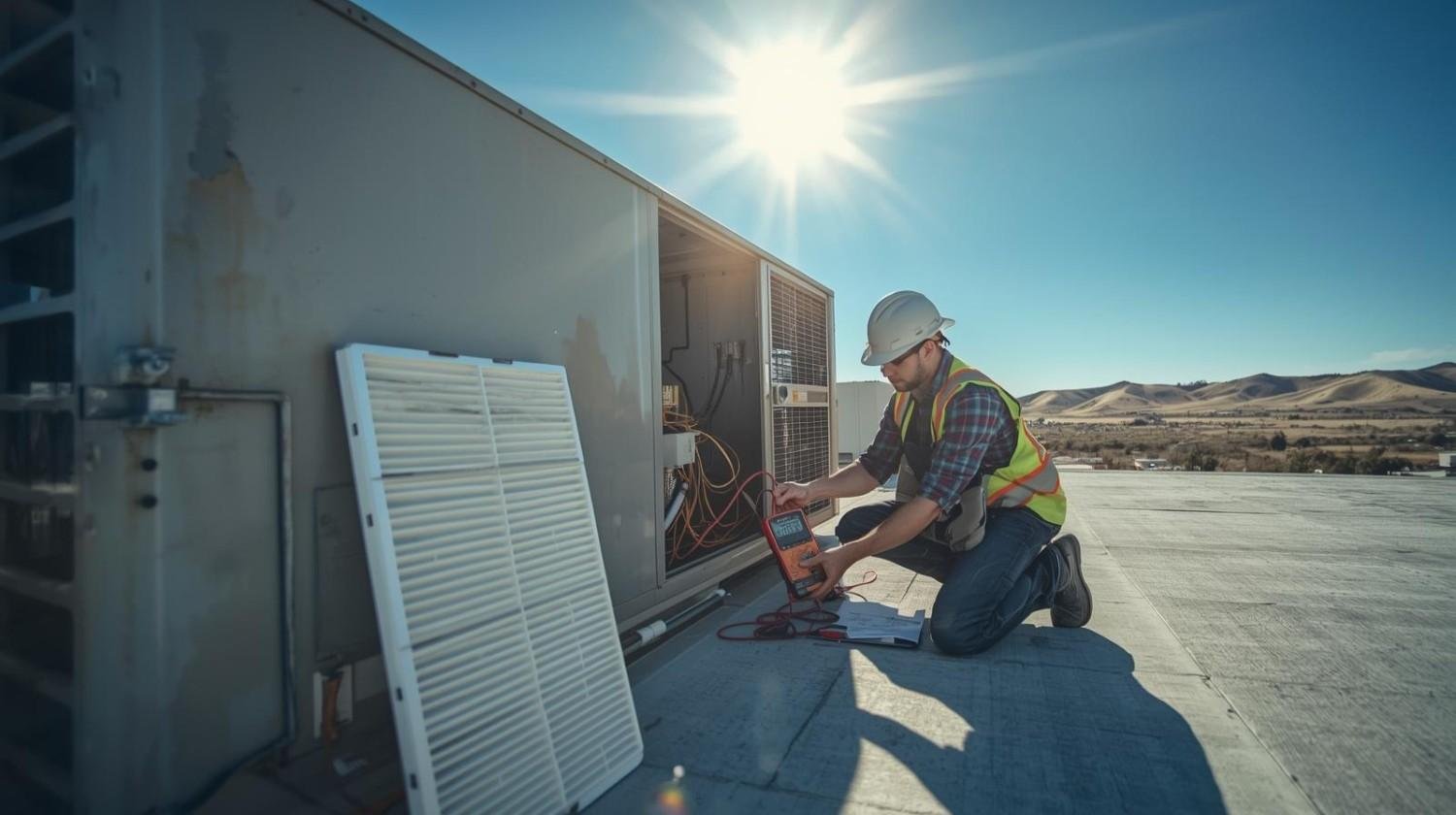
RTUs take the harshest exposure. They sit in direct sun and wind. They collect dust, leaves, and debris. That makes routine inspection critical.
NREL’s guide is direct about schedule. It recommends regular inspection of RTUs quarterly, semiannually, and annually, and it calls out coil condition, belts, controls, economizers, and drainage systems as routine items.
If your business relies on an RTU, do not treat it like a residential split system. It needs a documented schedule.
Filtration and Indoor Air Quality for Businesses (Dust + Smoke Playbook)
You need a filtration plan that protects indoor air without choking airflow.
Step 1: Match filter rating to system capability
California DIR smoke guidance notes most HVAC systems can accommodate pleated medium-efficiency filters rated MERV 6 to 11, and some may be able to use MERV 13 or more. This tells you two things:
- Many systems can upgrade from cheap filters.
- Not every system can handle MERV 13 safely.
Step 2: Set a smoke-event mode
During smoke:
- Change filters more often.
- Run the fan more consistently if your system allows it.
- Keep doors closed and reduce outdoor air intake if your system settings and safety requirements allow it.
Step 3: Create a “cleaner air” area
For customer-facing operations, designate one zone with the best filtration and the strongest airflow. Use it as a relief zone during smoke or heat spikes.
What Works vs What Doesn’t (Real-World Lessons)
What works
- A documented maintenance schedule that you can show on request
- Coil cleaning and airflow verification
- Capacitor testing and contactor inspection before peak season
- Drain line checks to prevent ceiling and roof leak claims
- Economizer inspection, since stuck dampers waste energy and reduce comfort
What doesn’t
- “Filter changes only” maintenance
- Ignoring coil condition until the unit trips on high pressure
- Waiting for the first heatwave to call for service
- Running the system with blocked returns, which raises static pressure and burns motors
If you want a Menifee-specific prevention angle that also ties into residential readers, link here to How to Protect Your Outdoor HVAC Unit During Menifee’s Dusty Season.
Maintenance Contracts in 2026: What You Should Demand
A maintenance contract should reduce your risk. It should not be a vague promise.
Here is what you should demand in writing:
- A full equipment asset list (model, serial, location, tonnage)
- A checklist that matches quarterly, semiannual, and annual schedules
- Photos of coil condition and any major findings
- Clear response time expectations
- Clear after-hours terms
- Clear terms for small parts versus major repairs
If you are budgeting for replacements, link this section to The Cost of Appliance Repair in Menifee vs. Buying New, because many small businesses need a unified budget for both appliances and HVAC.
A 30-Day Maintenance Reset Plan for Menifee Businesses
If you have no plan today, use this 30-day reset.
Week 1: Build your asset and filter map
- List each HVAC unit and its location
- Note filter sizes and quantities
- Record thermostat locations and schedules
Week 2: Schedule a baseline inspection
Have a service provider inspect coils, electrical components, drains, and control settings. NREL highlights these items as routine checks across quarterly and semiannual schedules.
Week 3: Align with indoor heat protection requirements
Since indoor heat protections apply at 82°F, plan how you will respond if indoor temps climb during a heatwave. HVAC maintenance supports this plan because it reduces the chance your system underperforms during peak heat.
Week 4: Set the calendar and reporting rhythm
- Lock in quarterly visits
- Set monthly in-house checks
- Require a post-visit report every time
Commercial HVAC maintenance in Menifee is not optional if you want predictable costs and fewer emergencies. A clean schedule gives you stable comfort, better energy performance, and fewer surprise shutdowns.
If you want a baseline inspection or a quarterly plan, reach out through contact Appliance Repair Menifee. If you want to see all services first, visit Appliance Repair Menifee.