You can live with dust on your patio furniture. You can wipe it off your car. However, you cannot ignore dust on your outdoor HVAC unit.
In Menifee, dusty wind events can hit hard, especially during Santa Ana conditions. Santa Ana winds bring hot, dry air and low humidity from inland deserts, and they typically occur from early fall to early spring, peaking in December and January. That combination pushes dust and debris into your condenser coil and into the outdoor cabinet.
When dust builds up on the coil, your unit cannot release heat fast enough. Your AC runs longer, your bill climbs, and your compressor takes extra stress. For a home, that can mean weak cooling and a surprise breakdown. For a business, that can mean comfort complaints, downtime, and urgent service calls during peak season.
This guide gives you a clear, actionable protection plan for Menifee’s dusty season. You will learn what dust damages, what to do before and after a wind event, what works, what does not, and when to call a pro.
Why Menifee’s Dusty Season Hits HVAC Units Harder Than You Think
Dust is not just a nuisance. Dust is an HVAC performance problem.
Santa Ana winds move dry air and can worsen fire conditions, and they peak in winter months. These winds often carry fine particles. Those particles pack into the coil like felt. Your condenser coil needs clean airflow to reject heat. When the coil clogs, your system loses capacity and burns more electricity to do the same job.
This is why you might notice a pattern. Your AC works fine on a mild day. Then a windy week hits, and the house never cools as quickly. The system still runs, but it struggles.
What Dust Damages on an Outdoor Unit
Your outdoor HVAC unit is called the condenser in a split system. It contains the condenser coil, fan motor, compressor, and key electrical components. Dust attacks all of them in different ways.
Condenser coil fins
The coil is a radiator. Air must move through it. Dust blocks airflow, so heat stays trapped in the refrigerant. That forces the compressor to run hotter.
Some sources cite large efficiency drops from dirty coils. One example reports that an EPA study found that a small amount of dirt on condensing coils can cause a 21% drop in efficiency and increase refrigeration energy use by 35%. Even if your real-world results vary, the direction is consistent. Dirt raises energy use.
Fan motor and blades
Dust sticks to the blades. Debris can also bend blades or unbalance the fan. The fan then vibrates and strains the motor bearings. Noise is often the first warning sign.
Electrical compartment contamination
Fine dust can enter the cabinet and settle on contactors, relays, and wiring. Combined with heat, that can shorten the life of these parts.
The Cost of Doing Nothing (Residential + Commercial)
If you do nothing, you pay in three ways.
- Higher bills. The unit runs longer to hit the same thermostat setpoint. Dirty coils can drive large efficiency losses in published studies.
- Higher breakdown risk. Heat and restricted airflow push the compressor into stress.
- Higher downtime cost. Businesses face tenant complaints, customer discomfort, and lost productivity.
You do not need perfection. You need a repeatable plan that reduces coil loading and keeps airflow stable.
Menifee Dust Plus Fire Season (2026 Reality)
Dust is bad. Dust plus smoke residue is worse.
Wildfire smoke contains fine particles and sticky residues. Those residues can cling to surfaces and mix with dust, creating a dense layer on coils and filters. If you manage a commercial site, you also have worker safety responsibilities during smoke events.
California’s Division of Occupational Safety and Health notes that most HVAC systems should accommodate pleated medium-efficiency filters rated MERV 6 to 11, and some systems may be able to use MERV 13 or more. This guidance helps you plan filter upgrades for smoke weeks, but you still must confirm your system can handle the added resistance.
This is also where proactive maintenance protects you. Clean coils and correct filters reduce the risk of coil freeze-ups and airflow alarms during a smoke week.
Your DIY Protection Checklist (Do This Before the Winds Pick Up)
You can protect your condenser with simple steps. Start before the windy season, then repeat after major wind events.
Step 1: Shut off power the right way
Turn off the thermostat first. Then shut off the outdoor disconnect box near the unit. This prevents accidental startup while your hands are near the fan.
Step 2: Clear the “dust zone” around the unit
Walk a 3-foot circle around the unit and remove:
- Loose leaves and tumbleweeds
- Grass clippings
- Bags of soil or mulch
- Patio items that can blow into the coil
This step matters more than most people think. If you store mulch next to the condenser, the coil becomes a vacuum.
Step 3: Rinse the coil safely
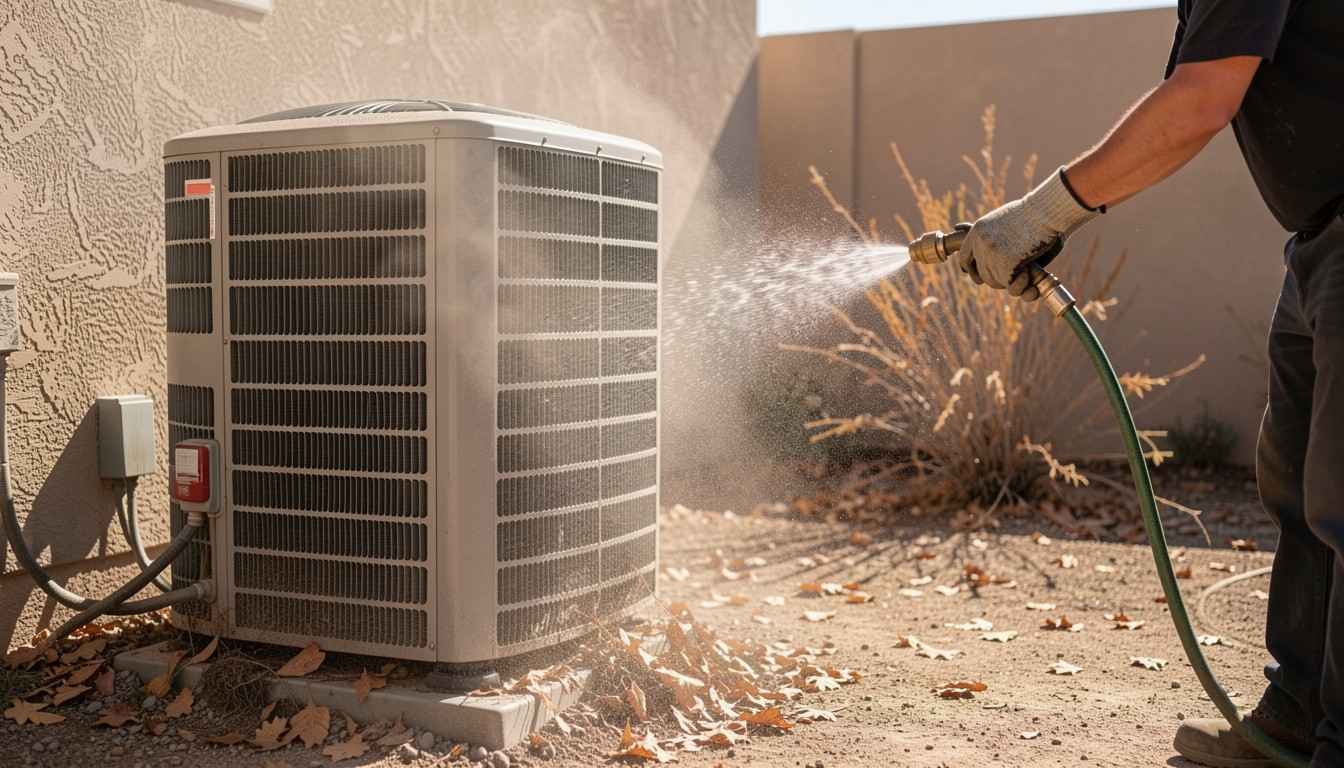
Use a garden hose with a gentle spray. Do not use a pressure washer. High pressure bends fins and traps dirt deeper inside.
Do this rinse method:
- Spray from the top down on the outside of the coil.
- Move slowly around all sides.
- Stop if water starts pooling or backing up.
If your coil is matted with heavy dust, a rinse will not fully remove it. You may need a coil-safe cleaner or a professional deep clean.
Step 4: Use a coil guard only if it does not restrict airflow
Some screens and guards block big debris. Others restrict airflow. If the screen is too fine, it becomes a dust blanket and causes the same problem as a dirty coil. Choose a guard with large openings and easy removal.
Step 5: Adjust your filter strategy to protect the whole system
Your outdoor unit suffers when your indoor airflow drops, too.
- Use a pleated filter that your system can handle.
- Change it more often during dust and smoke events.
- If you manage a workplace, review the filter guidance that notes MERV 6 to 11 as common, with some systems able to use MERV 13 or higher.
If you want a full seasonal plan, link here to Preparing Your Menifee Home for the Summer Heat: An HVAC Checklist.
What Works vs What Doesn’t (Real-World Methods)
What works
- Gentle rinsing after wind events
- Keeping the unit’s clearance zone clean
- Consistent filter changes during dusty weeks
- Scheduling a professional coil clean when dust mats into the fins
What does not work
- Pressure washing the coil
- Covering the unit while it is running
- Using harsh chemicals that corrode coil fins
- Adding a tight screen that starves airflow
If you want a larger home protection plan that includes appliances, this is a good place to link to Top 5 Most Common Appliance Repair Calls We Get in Menifee, because dust and heat often show up as root causes across systems.
Advanced Protection for Property Managers and Commercial Sites
If you manage a commercial property, you need a repeatable schedule and a documentation habit.
Use a dust-based maintenance cadence
Instead of “twice per year,” set cleaning based on exposure:
- High dust exposure sites: inspect monthly during windy season
- Moderate exposure sites: inspect every 6 to 8 weeks
- Low exposure sites: inspect quarterly
Standardize your inspection checklist
Have your team check:
- Coil cleanliness and airflow path
- Fan vibration and noise
- Electrical cabinet dust accumulation
- Drainage around the pad
- Outdoor disconnect condition
Track comfort complaints like a maintenance sensor
If tenants complain about “weak cooling” after a wind event, treat that as a trigger to inspect coils and filters immediately.
2026 Best Practices: Cleaning Methods and Products
This section prevents damage from well-meaning DIY work.
Use coil-safe cleaners only
Coils are aluminum. Many harsh cleaners can corrode aluminum. If a cleaner is not labeled for HVAC condenser coils, skip it.
Know when a rinse is not enough
If you see:
- A grey felt-like layer that water will not penetrate
- Bent fins that trap dirt
- Oily residue from smoke events
Then you need a deeper cleaning method. That may include foaming coil cleaner and a controlled rinse process.
Stop DIY if you see fin damage
Bent fins reduce airflow permanently unless you straighten them with a fin comb. If you tear fins, you reduce capacity and raise compressor stress.
When to Call a Pro (Before a Compressor Problem Starts)
Call for professional help if you notice these signs:
- The unit runs longer than normal after a wind event
- The outdoor fan sounds louder or wobbles
- Your thermostat never reaches setpoint during mild weather
- Your breaker trips or you smell electrical burning
A professional tune-up can include deeper coil cleaning, electrical checks, and performance verification. It also reduces the risk of a mid-season emergency.
If you want to understand why airflow and coil condition tie directly to local failure rates, link here to Why AC Units in Riverside County Fail Faster Without Maintenance.
To book service, use contact Appliance Repair Menifee. If you want to review all services first, use Appliance Repair Menifee.
Seasonal Maintenance Schedule for Menifee
Use this schedule and you will avoid most dust-related failures.
Spring (before heat ramps up)
- Rinse condenser
- Replace filter
- Clear the pad area
- Test thermostat settings
Summer
- Check filter monthly
- Rinse condenser after windy weeks
- Watch for long run times
Fall and winter (wind events and Santa Ana conditions)
Britannica notes Santa Ana winds peak in December and January and occur from early fall to early spring. Treat each major wind event as a trigger.
- Inspect coil after wind events
- Clean debris from the coil guard or base pan
- Change filters more often during dust and smoke events
After wildfire smoke exposure
- Replace filters
- Inspect coil for sticky residue
- Schedule a deep clean if residue remains
California guidance on wildfire smoke notes filter ranges most systems can handle, which helps you plan your response during smoke episodes.
Dust protection is simple when you do it early and repeat it. If you want help setting a schedule for your home or commercial site, reach out to Appliance Repair Menifee. A short visit can prevent a long breakdown.