You bought a home in Menifee, and it came with a central air conditioning system. Maybe you checked the manufacturing date on the unit and saw it was only five or six years old. You thought, “Great, I won’t have to worry about this for another decade.”
Think again.
If you lived in Santa Monica or Newport Beach, that AC unit might last 20 years. But you live in Riverside County. Here, the rules of HVAC survival are different. Our geography, heat intensity, and air quality combine to create a hostile environment for mechanical equipment.
In Menifee, an air conditioner does not just “run.” It fights a daily battle against extreme thermal stress and fine particulate dust. Without strategic support, that battle ends early. We see it every summer: compressors seizing up at seven years old and condensers rotting out at ten.
This guide explains exactly why our local climate destroys AC units faster than the national average and what you can do to stop it.
The “Inland Empire Tax” on HVAC Systems
We often talk about the “Sunshine Tax” in California, referring to the high cost of living. In the HVAC world, there is an “Inland Empire Tax.” You pay this tax in the form of shorter equipment lifespan.
Geography is Destiny
Menifee sits in a valley surrounded by hills. This topography traps heat. While coastal cities enjoy a natural cooling breeze from the Pacific Ocean, our valley acts like an oven. We consistently record temperatures 10 to 15 degrees hotter than areas just 40 miles west.
This means your AC unit runs more hours per day and more days per year. A unit in San Diego might run for 800 hours a year. Your unit in Menifee likely runs for 1,600 to 2,000 hours a year. In terms of wear and tear, one year in Menifee equals two years on the coast.
The 30% Lifespan Penalty
The data supports this. National averages suggest a central AC system lasts 15 to 20 years. In Riverside County, the average lifespan drops to 10 to 12 years for units that receive average care. That is a 30% reduction in useful life.
The 2026 Replacement Cost Shock
Replacing a unit early is more painful now than ever before. Inflation and new regulatory mandates have driven equipment prices up. In 2024, a standard change-out might have cost $8,000. In 2026, with the phase-out of R-410A refrigerant and new SEER2 efficiency standards, average replacement costs in our area are hitting $11,875 and up. Protecting your existing unit is the single best financial investment you can make this year.
Enemy #1: Thermal Cycling & Metal Fatigue
Heat alone is tough on machines. But fluctuating heat is worse. Menifee is famous for its temperature swings. It might be 105°F at 3 PM and drop to 65°F by 4 AM.
The 40-Degree Swing
This daily 40-degree fluctuation causes “Thermal Cycling.” Every metal component in your outdoor condenser expands when it gets hot and contracts when it cools down.
Imagine bending a paperclip back and forth. Eventually, it snaps. The same thing happens to the copper refrigerant lines and the brazed joints inside your AC. They expand and contract thousands of times a summer. This physical movement stresses the metal. Over time, it creates microscopic cracks that turn into refrigerant leaks.
The “Vibration” Effect
Your compressor vibrates when it runs. When you combine this vibration with the thermal expansion mentioned above, you get loose connections.
We frequently find electrical wires that have wiggled loose from their terminals. This creates resistance (heat) at the connection point. It eventually melts the wire or the terminal block, causing a sudden system failure. In a stable climate, these connections stay tight for years. In Menifee, they need annual tightening.
Compressor Stress
When it is 105°F outside, the pressure inside your AC system skyrockets. The compressor has to work much harder to pump the refrigerant against this high “head pressure.” If your system short-cycles (turns on and off rapidly) during these high-heat windows, the stress multiplies. This is the primary reason we see dead compressors in units that are less than 10 years old.
Enemy #2: The “Menifee Dust” (It’s Not Just Dirt)
Look at your patio furniture after a windy afternoon. That fine, brown layer of dust is not just soil. It is often fine clay and silica from the surrounding undeveloped hills and construction sites.
Fine Particulates vs. Standard Filters
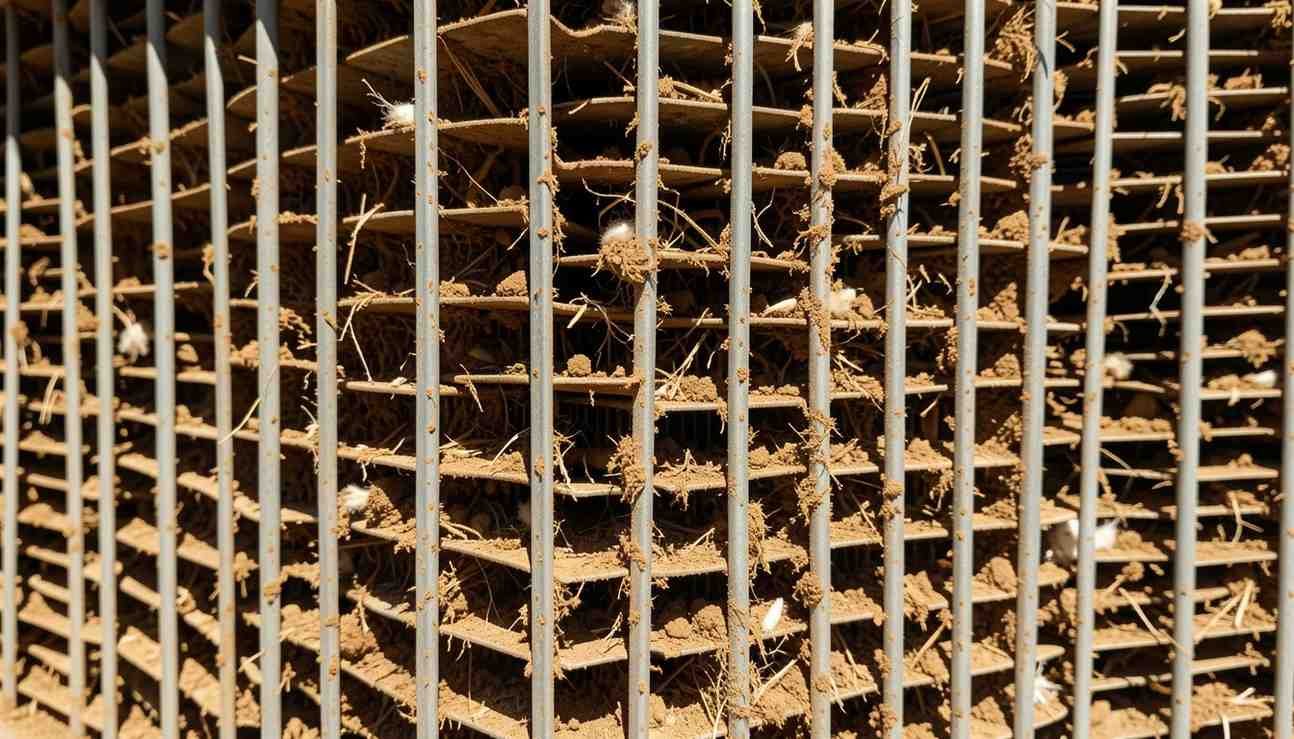
Standard blue fiberglass filters are useless here. They stop cat hair, but they let the fine Menifee dust pass right through. This dust travels through your ducts and lands on the indoor evaporator coil (the part that gets cold).
The “Insulator” Blanket
When dust mixes with the condensation on the cold coil, it turns into mud. This mud dries into a hard crust.
This crust acts like a wool blanket. It insulates the coil. The refrigerant inside the coil cannot absorb heat from your house because the dust is blocking it. EPA data indicates that just 1/16th of an inch of dust on a coil reduces heat transfer efficiency by 21%. Your AC runs longer to do the same amount of work.
Motor Burnout
Dust also coats the blower wheel (the fan inside your furnace/air handler). The heavy dust adds weight to the fan blades. It also disrupts the aerodynamics of the fan. The blower motor has to work harder to spin this heavy, dirty wheel. This generates excess heat in the motor windings, leading to premature burnout.
Enemy #3: The Capacitor Killer (Extreme Heat)
If you have ever had your AC stop working on the hottest day of the year, it was likely a capacitor failure. The capacitor is a small cylinder that acts like a battery to give your compressor the jolt of energy it needs to start.
Heat vs. Electronics
Electronic components hate heat. Most capacitors are rated to operate safely up to 158°F.
On a 105°F day in Menifee, the sun beats down on the metal cabinet of your outdoor unit. The internal temperature inside that cabinet—where the capacitor lives—can easily exceed 165°F. You are literally cooking the electronics. The oil inside the capacitor boils and expands.
The “Swollen” Sign
When a capacitor fails, the top often bulges out like a soda can that has been frozen. It loses its ability to hold a charge.
When the capacitor gets weak, it cannot give the compressor a strong enough push. The compressor tries to start, hums loudly, and then overheats. This puts massive strain on the compressor windings. A $200 capacitor failure can destroy a $2,000 compressor if you keep trying to run the unit.
Hard Start Kits
This is a specific upgrade we recommend for almost every home in Riverside County. A “Hard Start Kit” is an additional capacitor and relay that assists the compressor during startup. It reduces the time it takes to start by up to 50%. This minimizes the heat generated during startup and saves the compressor from the Menifee heat strain.
Enemy #4: The “Wildfire Season” Aftermath
We have a “fifth season” in California: Fire Season. When fires burn near Lake Elsinore or in the San Bernardino mountains, the smoke drifts into our valley.
Smoke is Sticky
Wildfire smoke is not just ash. It contains resins and oils from burning vegetation. When this oily smoke gets pulled into your outdoor condenser, it sticks to the fins.
Unlike regular dust, you cannot just rinse this off with water. The oily residue binds to the metal. It attracts more dust, building a thick, concrete-like layer on your coils.
Acidic Corrosion
When this smoke residue gets wet (from rain or morning dew), it can become slightly acidic. This acid eats away at the aluminum fins of your condenser. Over time, the fins become brittle and crumble away. Once the fins are gone, your unit cannot release heat, and it effectively dies.
The Post-Fire Tune-Up
After a heavy smoke season, standard cleaning is not enough. You need a chemical coil cleaning. We use a specialized foaming cleaner that dissolves the oily smoke residue and pushes it out from the center of the coil, restoring the metal to a clean state.
The Cost of Neglect vs. Maintenance
You might think skipping the $100-$150 annual tune-up saves money. The math proves otherwise.
The 5% Efficiency Drop
Studies show that an AC unit loses about 5% of its efficiency for every year of operation without maintenance. By year five, your unit is 25% less efficient than the day you bought it.
If your average summer electric bill is $400, a 25% loss means you are wasting $100 every single month. Over a long Menifee summer, you waste more on electricity than the cost of the maintenance visit.
Warranty Voiding
Read the fine print on your equipment warranty. Brands like Carrier, Lennox, and Trane require proof of regular professional maintenance to honor their parts warranty.
If your compressor dies at year eight, the manufacturer will ask for service records. If you cannot provide them, they can (and often do) deny the claim. You could be on the hook for a $2,000 part because you skipped a tune-up.
Our “Inland Empire Protection” Plan
Generic maintenance lists do not work here. At Appliance Repair Menifee, we developed a protocol specifically for this climate.
We do not just “check” the capacitor; we test it under load. We do not just rinse the coil; we use chemical agents to strip the clay dust. We tighten every electrical connection to torque specifications to fight the thermal vibration. We check the refrigerant subcooling to ensure the system handles the 105°F heat load correctly.
Conclusion
Your air conditioner is the most expensive appliance in your home. In Riverside County, it is also the most abused. The heat, the dust, and the vibration are relentless.
You cannot change the weather, but you can change how you protect your investment. Do not wait for the system to scream for help. By then, the damage is usually permanent.
Treat your AC like you treat your car. Give it the oil changes and tune-ups it needs to survive the desert highways. If you suspect your system is struggling, or if you haven’t had it looked at in over a year, reach out to us. Let’s make sure your home stays cool when the next heatwave hits.
Frequently Asked Questions (FAQs)
Why did my AC break after only 8 years?
In Menifee, 8 years of runtime is roughly equivalent to 12 or 15 years in a coastal city. Your unit runs longer hours under higher temperatures. If it wasn’t maintained annually, the thermal stress and dust buildup likely accelerated the wear on the compressor or condenser coils.
How often should I change my filter in Riverside County?
Forget the “every 3 months” rule on the package. During the summer and fire season, you should check your filter every 30 days. If you hold it up to the light and can’t see through it, replace it. A clogged filter is the fastest way to kill a blower motor.
Is a "Hard Start Kit" worth it for Menifee homes?
Absolutely. It is one of the best upgrades for our climate. It reduces the electrical strain on your compressor during startup by up to 50%. Since your AC starts and stops dozens of times a day, this kit significantly extends the life of your compressor.
Can I just hose off my AC unit myself?
You can rinse off surface fluff, but be careful. If you spray water at high pressure directly into the fins, you can push the dirt deeper into the coil, creating a mud pack that is impossible to remove without disassembling the unit. Always use a gentle spray and aim downward. For a deep clean, you need chemical agents and professional tools.
Does dirty ducts affect my AC lifespan?
Yes. If your ducts are dirty or undersized, it creates high “static pressure.” Imagine trying to breathe through a straw while running. Your blower motor has to push against this resistance. This causes the motor to overheat and fail prematurely. Keeping ducts clean helps the equipment breathe easier.